
Last week, I was at a busy networking event in London. The room was full of founders, freelancers, and remote professionals exchanging business cards, scanning QR codes, and typing quick notes into their phones. I met five people I genuinely wanted to stay in touch with.
And guess what? Two days later, I hadn’t contacted any of them.
Sound familiar?
If you attend enough events, you know this feeling. Modern networking isn’t just about meeting people anymore. It’s about what happens after the introduction. Without a clear system, even great conversations at events, in flexible workspaces, or during online meetups quickly disappear.
In 2026, networking is naturally hybrid. You connect online, meet in person, and follow up digitally. Somewhere between those steps, things get lost. The tools that are supposed to help, digital business cards, CRMs, calendars, often make the process more complicated instead of easier.
That’s why the discussion around face to face networking vs online networking benefits is still relevant. Neither approach works perfectly on its own. The real challenge for professionals today is finding a way to combine both without losing efficiency and productivity.
Networking Today: The Hybrid Reality
As you know, back in 2020, almost everything went digital. COVID reshaped the way we work and connect. Conferences, team meetings, introductions, even casual chats over coffee, moved online. For a while, virtual networking was all there was. You met people on Zoom, exchanged LinkedIn invites, and pinged messages in Slack channels. It was fast and convenient, but it often felt flat.
When in-person events started returning, the energy of face-to-face interactions reminded everyone why humans crave real connection. You could read subtle gestures, hear the tone behind words, and feel the shared energy of a room. Suddenly, networking wasn’t just about exchanging contact info; it was about creating trust, spark, and memorable first impressions.
Fast forward to today, and we live in a hybrid networking reality. Some relationships start online, others offline, and most move back and forth between the two. You might meet someone at a coworking event, scan a digital business card, follow up on LinkedIn, ping them on Slack, and schedule a Zoom call. Your network exists across platforms, moments, and formats, and it’s easy for pieces to get lost in the shuffle.
Here’s the reality you probably recognize: face-to-face interactions create strong first impressions but are easy to lose without follow-up. Online tools make it easier to stay in touch, but conversations often lack depth and context. The result? It’s not a smooth system, it’s a fragmented process. Every interaction happens in a different place, and without a way to connect those touchpoints, relationships lose momentum.
The Power of Face-to-Face Networking
Despite the rise of digital tools, face-to-face networking is still the fastest way to build trust.
Think about the last time you felt a real connection through a screen. It doesn’t happen often. Now compare that to meeting someone in person and having a meaningful ten-minute conversation. The sense of trust, the energy in the room, the clarity of the interaction, these things are difficult to replicate online.
If you attend events in flexible workspaces, conferences, or startup meetups, you start noticing small details: how someone speaks, the way they react, the energy they bring into a conversation. These cues create memory anchors, which make it much easier to remember the person later and follow up in a natural way.
Even something simple, like exchanging a smart business card or sharing a digital business card, can make the introduction feel smooth and professional. But first impressions alone don’t build relationships. Without a system for follow-up, even great conversations disappear.
You’ve probably experienced this yourself.
You meet an interesting founder at an event.
You exchange contact details.
You say you’ll follow up.
Then the week gets busy, priorities change, and the message never gets sent.
The connection fades, not because it wasn’t valuable, but because there was no clear structure to maintain it.
This is where many professionals lose the real benefit of networking. Not because they don’t care, but because modern networking requires more than memory. It requires a structured process.
Online Networking: Benefits and Pitfalls
Now think about online networking. Platforms like LinkedIn, Slack communities, and virtual events make it possible to connect with professionals all over the world in minutes. With the right digital networking tools, you can discover people who match your interests, keep track of conversations, and stay in touch without relying on handwritten notes or scattered apps.
Online networking becomes especially powerful when your work isn’t limited to one location. If you collaborate with remote teams, attend international events, or work with clients in different countries, digital tools help you scale your network in ways that traditional methods never could. A virtual card or contactless sharing solution, for example, makes exchanging details quick and effortless.
But speed doesn’t guarantee real connection. Many professionals know this pattern: you connect online, exchange a few messages, and then the conversation slowly disappears. Without context, follow-up, or a clear reason to stay in touch, the relationship never develops.
This is where online networking can turn into a productivity problem instead of a productivity advantage. When you are already managing projects, deadlines, and remote collaboration, every new contact adds another layer of information to organize. That’s why attention management and priority management become essential. You need a way to decide which connections matter, when to follow up, and how to keep the relationship moving forward.
Networking Workflow: Where Most Systems Fail
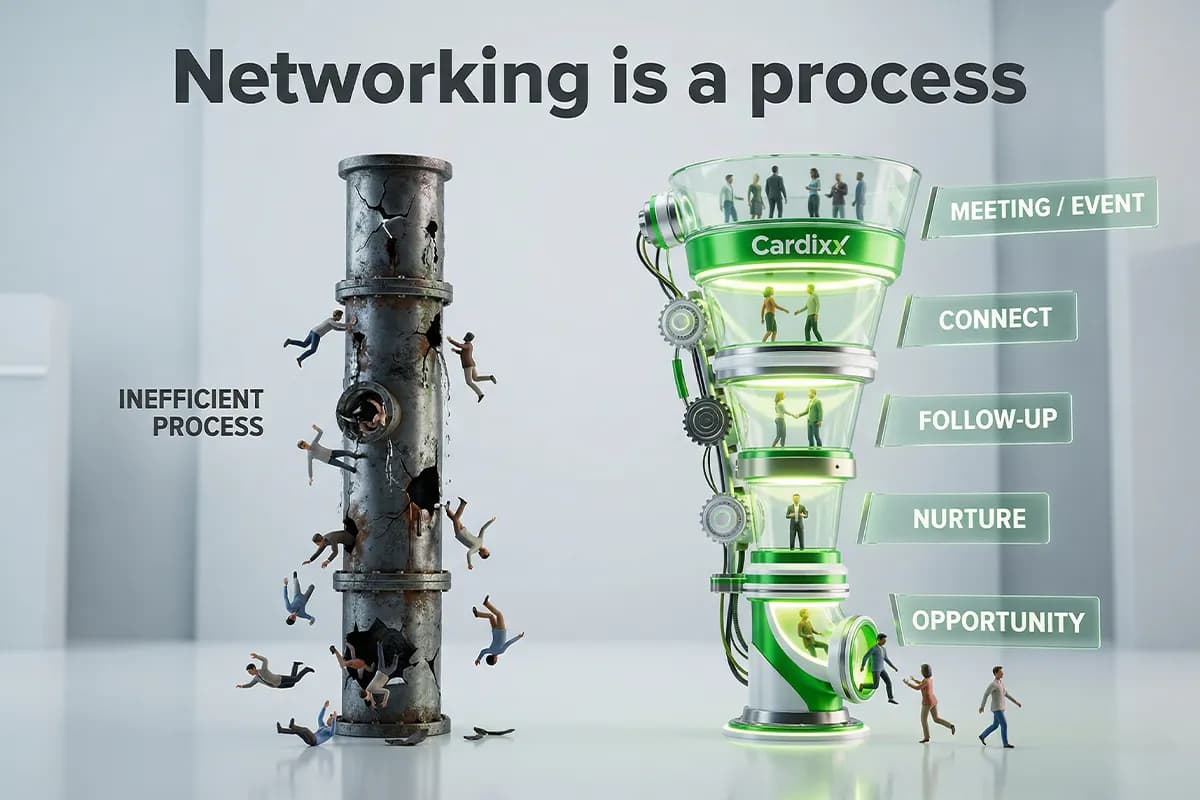
Networking isn’t a single action, it’s a process that unfolds over time.
You discover people, meet them, exchange contact details, follow up later, and try to maintain the relationship. The challenge is that most tools only support one part of this flow, not the whole experience.
Traditional business cards work at the moment you meet someone, but they don’t help you manage the relationship afterwards.
CRMs can store contacts, yet they often miss the context behind how the connection started.
Calendar reminders make follow-ups possible, but they don’t tell you which relationships are actually worth your time.
And many digital business card apps focus only on sharing information, without helping you organize or develop your network.
The result is familiar to many professionals. You attend events, add new contacts, and stay busy, but it’s hard to see real progress. Without a structured workflow, networking turns into a time-consuming task instead of an efficiency-boosting activity.
Cardixx: A System, Not Just a Card
There are already plenty of apps offering digital business cards. They make it easier to share your info, update details, and avoid fumbling through stacks of paper. But here’s the thing, what happens next?
Having a slick digital card doesn’t solve the real problem. If you don’t know who to connect with, where to go, or how to follow up, the app quickly becomes just another unused tool buried in your phone. Sound familiar? You’ve probably tried it, swiped through contacts, added a few people online, and then… nothing.
This is where Cardixx changes the game.
With Cardixx, you do create your digital card, but that’s just the beginning. The platform helps you discover nearby networking hubs where relevant professionals are already gathering. You can check in at your location, state your networking intent, and indicate who you’re looking to meet and why.
Imagine walking into an event and instead of blindly hoping to meet the right people, you filter the room for connections that align with your goals. You track interactions, measure engagement, and see which relationships are worth your time.
Cardixx doesn’t just improve a single moment like exchanging contact details. It optimizes the entire networking process, from discovery to structured connection to follow-up. It’s not about a better digital business card, it’s about making your whole professional networking system work, efficiently and productively.
In other words: instead of losing track of contacts, missing opportunities, or juggling platforms, you can focus on what really matters, building meaningful, actionable relationships that grow your network.
Bringing in All Together: Hybrid Networking in 2026
The debate between face-to-face and online networking isn’t a binary choice anymore. The most effective professionals combine both approaches, supported by structured tools that track, measure, and nurture relationships.
Face-to-face interactions build trust. Online tools keep connections alive. Platforms like Cardixx help you turn these relationships into action, while boosting your efficiency and productivity.
Networking today isn’t about collecting contacts. It’s about managing relationships, staying organized, and turning connections into opportunities.
If you want networking to work for you in 2026, focus on hybrid strategies: attend events, maintain digital follow-ups, and adopt tools that bridge the gap between human interaction and digital efficiency.
Because at the end of the day, it’s not just who you meet, it’s how you manage, nurture, and grow those connections that truly defines your professional success.