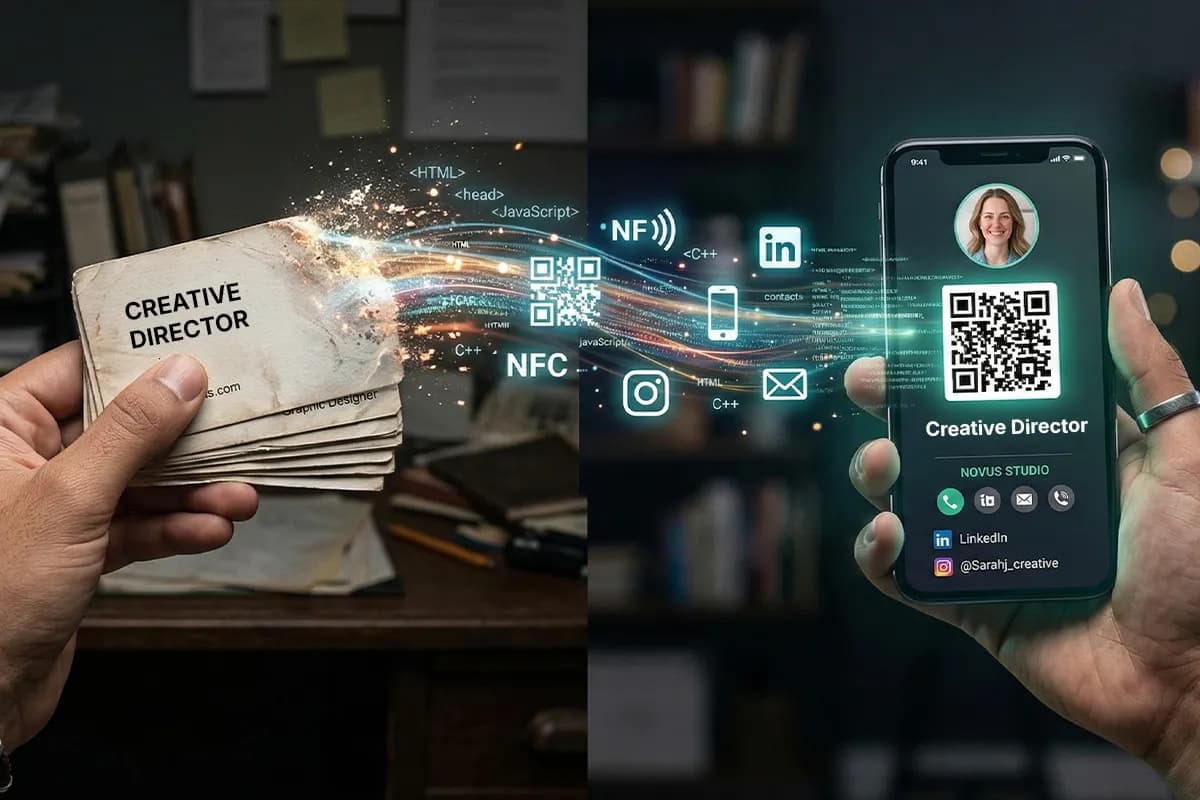

Business cards have been part of professional life for centuries. They began in 15th century China as formal introduction cards, later became calling cards in Europe, and eventually turned into commercial trade cards during the Industrial Revolution. With modern printing in the 20th century, they became standardized and mass produced.
For decades, they were essential.
A business card meant legitimacy. It helped you exchange contacts, find customers, introduce services, and establish trust. It was simple, physical, and effective for professional networking and building early business relationships.
Then the digital era arrived.
With LinkedIn and other online platforms, many professionals stopped carrying paper cards. It felt easier to just connect online through online networking platforms. But over time, people realized something: adding someone on LinkedIn is not the same as a real contact exchange. Connections became shallow. Messages were ignored. The system lacked intention.
That gap created space for digital business cards.
Now the conversation is no longer about whether business cards matter. It is about format.
In the debate of digital vs traditional business cards, which one actually delivers more value today?
Cost Comparison: Digital vs Paper
Whenever businesses evaluate a tool, cost is the first instinct.
Printed business cards look affordable. Ordering 100 cards may cost around 20 euros. Larger volumes reduce the price per card. Five hundred cards might cost around 39 dollars. One thousand around 52 dollars. The most common orders usually fall between five hundred and one thousand cards.
At first glance, that seems cheap.
But printing is rarely a one time expense. If your job title changes, your phone number updates, your design evolves, or an employee leaves the company, the remaining cards become useless. You reorder. The old ones go to waste.
Digital cards operate differently. Pricing varies by provider and across different digital business card solutions.
- HiHello offers a free plan with limited features. Its professional plan is approximately 6 dollars per month when billed annually. Business plans can reach around 25 dollars per user per month depending on team size and integrations.
- Popl provides a free digital option, but paid subscriptions typically range between 7 and 15 dollars per month. Additional costs may apply for physical NFC enabled products, often marketed as an NFC business card solution.
- Blinq also offers a free version. Paid plans generally range between 3 and 8 dollars per month per user, with higher pricing for business features.
- Then there are newer players like Cardixx, offering digital business cards for 19.90 euros per year with unlimited cards, and going beyond simple sharing by integrating face to face networking tools.
While digital subscriptions may initially feel more expensive than printing paper, the long term value shifts the equation. Updates are instant. No reprints. No waste. No storage boxes full of outdated information. That aligns with modern digital business card management expectations and the future of digital business card in digital workplaces.
The real cost comparison is not about price per card. It is about lifecycle cost and flexibility.
Sharing & Accessibility Differences
Paper cards are simple. You hand them over. No battery required. No scanning. No setup.
The exchange feels quick and familiar, especially during traditional networking events.
But what happens next?
Many paper cards are lost within days. Others sit in drawers. Very few are manually typed into phones. In a world where people barely carry cash and even bank cards are being replaced by phone payments, carrying stacks of paper feels increasingly outdated.
Digital cards match modern behavior. They are shared through QR codes, NFC taps, links, or email. A QR code card allows instant scanning and supports contactless sharing. Information saves directly into the recipient’s phone. Some platforms integrate with CRM systems, becoming powerful networking tools for remote and hybrid teams.
More importantly, digital cards are not limited to physical meetings. They can be shared during online calls, embedded in email signatures, posted on LinkedIn, or sent through messaging applications. This strengthens personal branding and helps build long term social capital.
In a hybrid world, reach matters.
Paper works in person.
Digital works everywhere.
That does not mean paper has no value. Premium paper still creates a sensory impression. A beautifully designed card can feel memorable, much like a carefully crafted smart business card.
But in a direct digital vs traditional business cards comparison, digital clearly wins in scalability and aligns with current networking trends.
Environmental Impact
There is also the environmental side.
Around 27 million business cards are printed every day. A large percentage are discarded within a week. That represents millions of pieces of paper produced only to become waste.
Printing requires paper, ink, energy, packaging, and transportation. When employees leave companies or rebranding happens, unused cards are thrown away.
In simple terms, we produce something temporary using permanent resources.
Digital cards eliminate printing entirely. No paper. No ink. No shipping. No physical waste when information changes. A virtual card or mobile card remains updated without environmental cost.
For companies positioning themselves as sustainable or environmentally conscious, this difference is significant. Moving away from paper aligns with modern environmental expectations and reduces unnecessary consumption.
From a sustainability perspective, digital solutions are clearly ahead.
Best Choice for Networking
When we step back and evaluate networking effectiveness, the answer becomes clearer.
Printed cards are static. They show a name, phone number, and maybe a website. They cannot be updated. They cannot track engagement. You cannot measure return on investment. You pay for printing and delivery. Their lifespan is short.
Digital cards, on the other hand, are dynamic and function as a complete digital profile. You can add portfolio links, videos, booking calendars, social profiles, and even payment links. Many platforms offer digital business cards with analytics and tracking, allowing measurable results from your networking efforts.
Yes, subscription pricing may look higher at first glance. However, providers such as HiHello, Popl, and Blinq offer monthly models with varying feature levels, while Cardixx provides a yearly plan at 19.90 euros that makes advanced digital business card tools highly accessible.
Considering behavior trends, environmental impact, update flexibility, measurable engagement, and pricing comparison across platforms, digital cards align better with how professionals network today.
Paper cards represent tradition.
Digital cards represent adaptability, data, and modern networking solutions.
And in the long term comparison of digital vs traditional business cards, digital solutions are increasingly becoming the smarter choice.
Not because paper stopped working.
But because the world changed.
Want more than a card? Get the full networking journey. Download Cardixx free on the App Store, Google Play, or cardixx.com. |