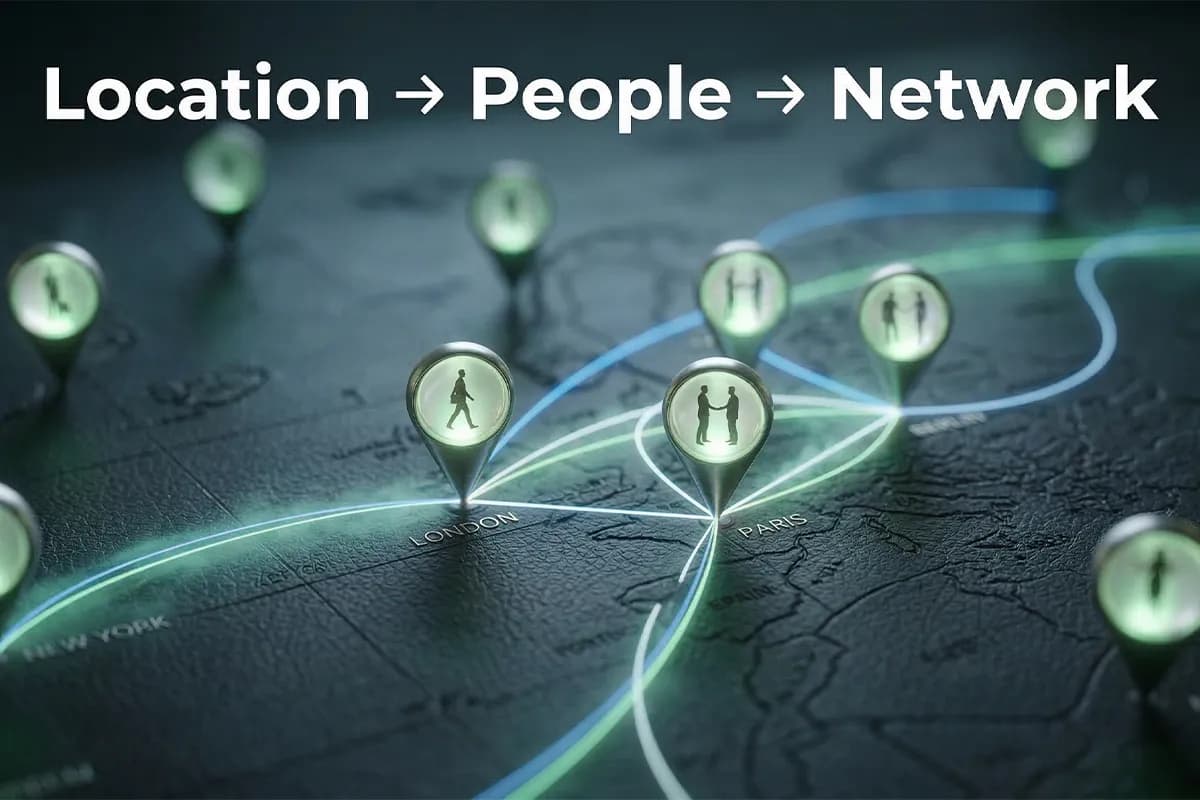

Summary: Professional networking is shifting back to face-to-face interaction as people seek more meaningful, real-world connections. To support this return, a new trend is emerging: location-based discovery, helping professionals find relevant people nearby and connect with greater intent.
Networking has long been the lifeblood of career growth and business success. While its importance remains constant, the way we approach professional networking network is undergoing a radical shift. For years, we saw a "BOOM" in online networking apps that allowed us to amass thousands of connections with people we may never meet, and likely never would.
As we move through 2026, a familiar pattern is returning: a deep desire for face-to-face interaction. Professionals are once again;
- Getting active in coworking spaces
- Attending networking events and conferences
- Joining programs for professional networking
- Seeking business relationships
The question is no longer whether in-person networking matters. It clearly does. The real question is: how can we make it smarter? This has given rise to a powerful new networking trend: location-based networking.
Check out the Networking Hubs available in Cardixx
What Is Location-Based Networking?
Location-based networking introduces a simple but powerful idea: what if you could see the professional relevance of the people around you?
Every day, we pass hundreds of individuals. at events, in shared office environments, in business cafés, or inside a growing startup ecosystem. Among them could be a future client, a co-founder, a hiring manager who strengthens your industry connections.
Yet without visibility, those opportunities remain invisible.
By adding a "location layer" to professional discovery, these platforms allow you to find people who are in the same room or just a few hundred meters away. It transforms physical proximity into professional opportunity.
Benefits for Professionals
Modern professionals are busier than ever. Time is scarce. Attention is fragmented. We travel across cities to attend networking events,hoping to apply the best networking practices, yet we end up in random conversations that don’t align with our goals.
Meanwhile, the person who could genuinely help us might be sitting two tables away — unnoticed.
Location-based discovery supports stronger networking management by reducing randomness and increasing relevance.
Instead of collecting contacts, professionals can build relevant relationships. Instead of chasing distant connections online, they can explore meaningful opportunities nearby.
This shift reflects broader professional networking trends: intentionality, efficiency, and measurable outcomes are becoming more important than sheer volume.
Use Cases: Where Hidden Opportunities Live
Consider events & conferences. Hundreds of attendees gather in one place. Energy is high, conversations are constant, yet many participants leave feeling they missed someone important. The challenge is not attendance; it is relevance.
The same applies to coworking spaces and universities. These environments are filled with potential collaborations. Founders look for technical partners. Freelancers search for clients. Students seek mentors. But without structured discovery, interactions remain largely accidental.
Location-based networking transforms these spaces into active networking hubs rather than passive shared office environments. The value of being in the same place is no longer just physical, it becomes contextual.
Future Trends: The Rise of Networking Hubs
Looking ahead, location-based networking will become the standard for any space that claims to foster connection.
Data-Driven Ecosystems
Currently, many coworking spaces and events claim to be great for networking, but they lack the data to prove it. In the future, these "Networking Hubs" will use real activity data such as the number of real connections made and peak networking times to optimize their environments.
Strategic Shifts for Physical Spaces
Places like universities and business cafés will need to rethink their networking management strategies. By understanding exactly why people visit—often for the community and industry connections—they can adjust their layouts and services to better support these real-world interactions. This reflects best networking practices for collaborative workspaces.
Measurable Networking ROI
Just as we track digital marketing, professionals and teams will soon track "networking ROI". Knowing which meetings turned into qualified leads will become essential for any serious business development team. This is particularly important for implementing networking strategies for startups and avoiding common networking mistakes.
Building Long-Term Value
Location-based networking is more than just a trend; it is the "operating system" for the next generation of professional growth. By bridging the gap between digital identity and physical presence, we can ensure that no important connection is ever missed again.
Download Cardixx for free on iOS
Download Cardixx for free on Android