
Summary: Are digital business cards safe depending entirely on the platform you choose. The right digital business card provider protects your contact information with encryption, GDPR compliance, and secure data handling. The wrong one puts your professional reputation and personal data at risk. As networking becomes more digital, a new question comes up more often.
Are digital business cards safe?
When you share contact information digitally, you are no longer just exchanging names and numbers. You are sharing personal data. That makes digital business card security, digital business card privacy, and data protection critical topics, especially in Europe.
This article explains how digital business cards store data, the real privacy risks in networking, how security works, and what GDPR compliance actually means in practice.
How Digital Business Cards Store Data
Digital business cards work by storing contact information on a digital platform.
When someone scans a QR code, taps an NFC card, or opens a shared link, the information is displayed from a server or cloud based system. Depending on the provider, data may include name, job title, company, email address, phone number, social links, and optional notes.
From a data protection perspective, this means personal data is being processed, not just shared.
In Europe, any system that processes personal data must follow GDPR rules. This includes how data is stored, where it is hosted, who can access it, and how long it is retained.
Well-built digital business card platforms use secure hosting environments, encrypted connections, and clear access controls. Poorly built tools may not.
This difference is what determines whether digital business cards safe is a yes or a no.
Privacy Risks in Networking
Traditional networking already has privacy risks. You hand someone a card. They can do anything with it. Add you to marketing lists. Share your information. You have no control.
Digital business cards can make these risks better or worse.
The better part: you can update or delete your information anytime. If you change jobs, you update your card. Everyone who saved it sees the new information.
The worse part: if your platform gets hacked, hundreds of contacts could be exposed at once. Digital QR code business cards involve sharing personal information digitally, which can be risky without proper security measures.
Another risk is tracking. Some platforms track when someone views your card, where they are located, which links they click. This data helps you understand engagement. But it also means the platform collects detailed information about your network.
Security Features Explained
Secure digital business card platforms use multiple layers of protection.
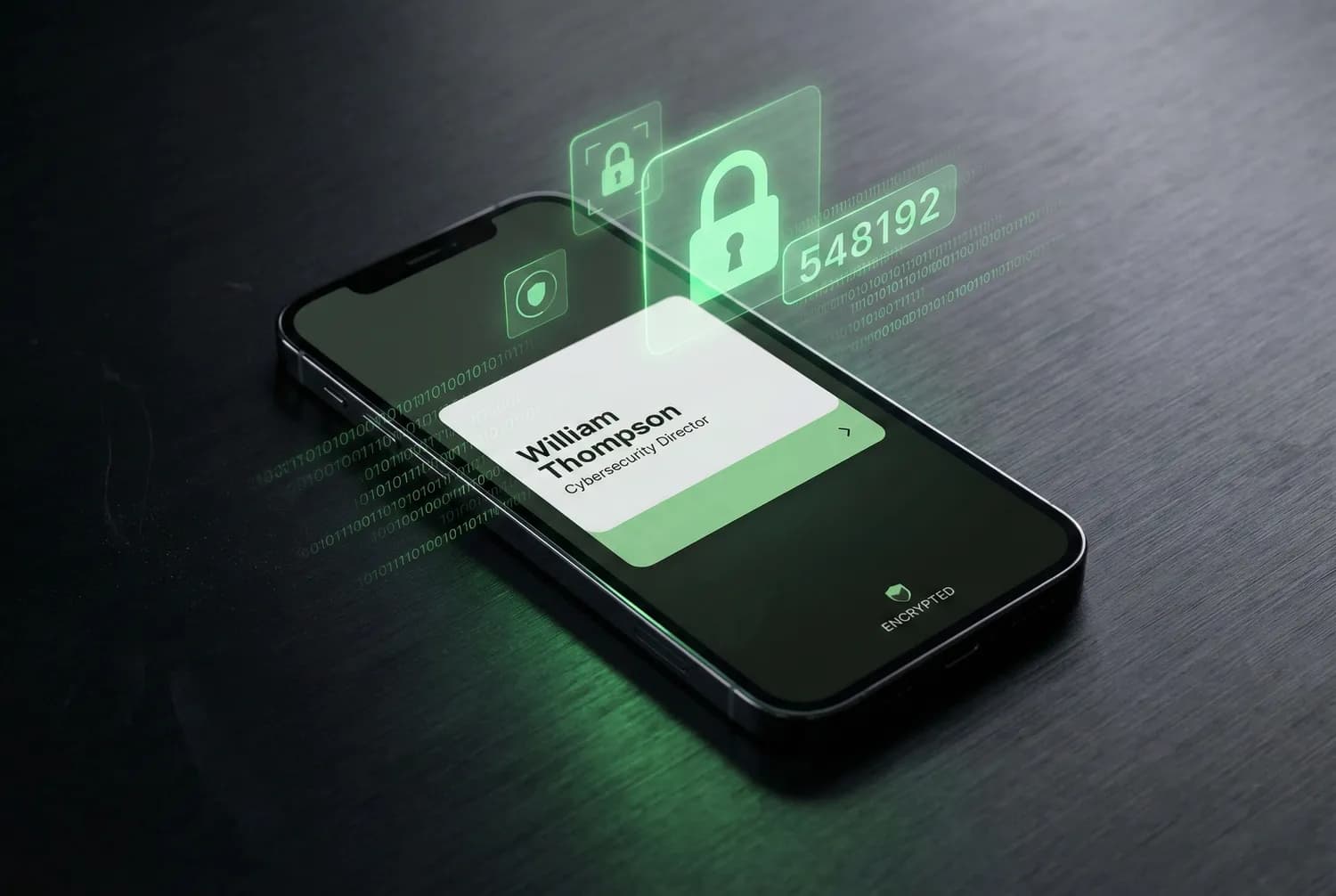
- Encryption protects your data when stored and when shared. 256-bit AES encryption at rest and TLS 1.2 encryption converts information into unreadable code accessible only to authorized users Uniqode.
- Authentication controls who can access your account. Two-factor authentication (2FA) adds a second layer of verification to prevent unauthorized access ShareEcard Weblog. Even if someone gets your password, they cannot access your account without the second factor.
- Access controls determine who can view or edit your card. Digital business cards implement strong access features like Single Sign-On (SSO) and Multi-Factor Authentication (MFA) Uniqode.
- Secure storage means your data lives on protected servers. Servers should be equipped with security features such as firewalls and intrusion detection systems QR Code Chimp.
GDPR and User Consent
In Europe, GDPR sets strict rules for how personal data must be handled. These rules apply to digital business cards.
Under GDPR, personal data must be
- Collected for a clear purpose
- Minimized to what is necessary
- Stored securely
- Processed transparently
- Deletable upon request
User consent is critical. People must understand what data they are sharing and how it will be used.
A GDPR compliant digital business card platform provides
- Clear privacy policies
- Explicit consent mechanisms
- Data access and deletion options
- EU compliant data processing agreements
If a platform does not support these basics, it should not be used for professional networking in Europe.
Best Practices for Safe Networking
Using digital business cards safely is not only about the tool. It is also about behavior.
Choose platforms that clearly explain their security and privacy practices. Avoid oversharing unnecessary personal information.
Use platforms that allow you to control visibility and data retention. Review privacy settings regularly.
Only collect contact data when there is a clear reason to follow up. When used correctly, digital business cards can actually improve trust in digital networking. They provide transparency, control, and accountability that paper cards never offered.
So, are digital business cards safe?
Yes, when they are built and used responsibly.
Digital business cards are not inherently risky. Poor privacy practices are.
In Europe especially, GDPR provides a strong framework that protects users when platforms follow the rules. The responsibility lies with both the provider and the professional using the tool.
If security, privacy, and compliance are taken seriously, digital business cards can be a safe and trustworthy part of modern networking.
Cardixx is hosted in Europe with full GDPR compliance & zero data selling.
Download Cardixx for free on iOS
Download Cardixx for free on Android