
Marketing has never been a more crowded profession. Everyone is a content creator, a growth hacker, a brand strategist, or a digital marketing consultant. The titles multiply, the niches get smaller, and the competition gets tighter. Yet at the same time, the demand for good marketing talent has never been higher either.
Here is what is happening in the market right now. A new wave of startups is launching every week. Engineers build the product. Developers write the code. And then, somewhere between the beta launch and the first real customer, the founders realize something uncomfortable: they have no idea how to market what they built. Marketing was always the thing they would "figure out later." Later has arrived.
This is creating a massive opportunity for freelance marketers, SEO specialists, brand strategists, social media managers, and independent agency owners. The clients are out there. The question is how you reach them before someone else does.
And that question leads directly to networking.
Why Marketing Professionals Need Digital Business Cards
Freelance marketers and independent agency owners wear many hats. One week you are doing SEO audits, the next you are running paid social campaigns, and the next you are helping a founder position their brand from scratch. Your work is diverse, your references are spread across industries, and your portfolio is constantly evolving.
When you meet a potential client, whether at an event, in a coworking space, or at a casual coffee introduction, you need to leave an impression that communicates all of that immediately. A paper card with your name and a phone number does not do that. It does not show your work. It does not link to your case studies. It does not tell the person standing in front of you what you actually do well and for whom.
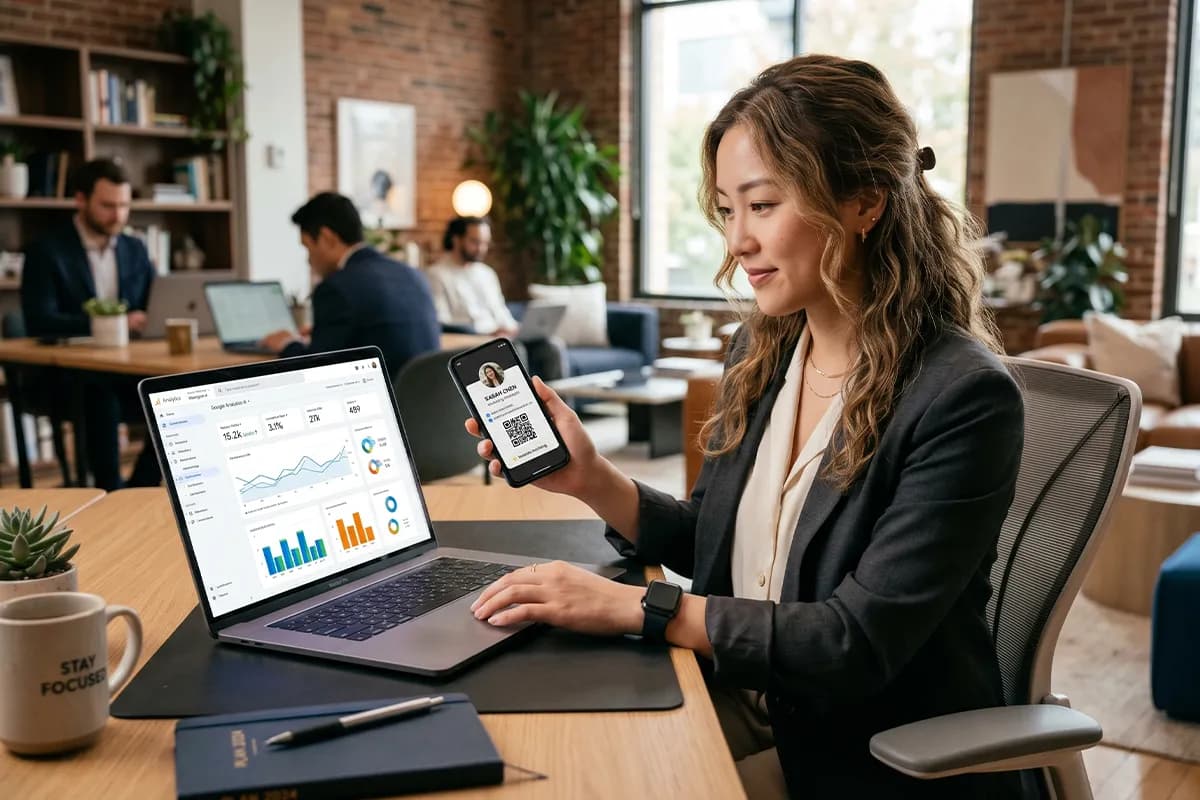
A digital business card does. In a single QR code scan, you can share your full professional profile: your name, your services, your website, your portfolio, your LinkedIn, your contact details, and even a short line about the kind of clients you work with. You can tailor it. You can update it in seconds when you pivot to a new service or want to highlight a recent project. No reprinting. No outdated information floating around in someone's drawer.
For marketing professionals whose entire value proposition is built around communication and first impressions, a digital card is not just a convenience. It is a statement.
Why Traditional Business Cards Do Not Work for Marketing Professionals
There is also a more practical reason to move away from paper cards, and it has nothing to do with technology. It has to do with reality.
Sustainability is no longer a fringe concern. Clients, partners, and collaborators increasingly pay attention to the choices professionals make, including small ones. Handing out printed cards in 2026 sends a subtle signal, and not necessarily a good one, especially if your potential client is a brand that takes its environmental values seriously.
But beyond sustainability, the lifespan of a paper business card is brutally short. Think about what actually happens to most of them. They get tucked into a pocket, transferred to a desk, buried under other papers, and eventually thrown away without ever being acted on. The follow-up never happens because the card was already forgotten by the time the person got home.
A digital card does not disappear. It lives in the recipient's phone, updated automatically whenever you change your information. If you rebrand, change your rates, launch a new service, or move to a new city, your contact updates itself everywhere it has already been saved. The person you met six months ago at a networking evening always has your current details.
For a freelance marketer whose services, focus areas, and contact points shift regularly, that automatic accuracy is genuinely valuable.
Turning Networking Into Marketing Clients
Timing matters in business development. The right conversation at the right moment can open a door that a hundred cold emails never could. And that moment, more often than people admit, happens in person.
This is why so many marketing professionals are deliberately choosing to work from coworking spaces rather than from home. Not just for the change of environment, but because coworking spaces are full of exactly the kind of people they want to meet. Startup founders. Small business owners. Consultants. Product managers. People who need marketing help and are surrounded by others who might recommend it.
The problem is that even in these environments, most connections stay surface level. You chat, you connect on LinkedIn, and nothing happens. The opportunity passes not because the fit was wrong but because the follow-up never had a foundation.
Digital business cards create that foundation. When you exchange a digital card with a founder you just met over coffee, they leave with your full profile, your references, and a clear picture of what you do. When you follow up three days later, they already know who you are. The conversation picks up where it left off rather than starting from zero.
Client acquisition for marketing professionals has always been relationship-driven. Digital networking tools make those relationships easier to start, easier to maintain, and much less likely to slip through the cracks at the wrong moment.
How Marketers Build Personal Brand Through Networking
All of this eventually comes back to one thing: personal brand. For a freelance marketer or an independent agency owner, you are not just selling a service. You are selling yourself. Your taste. Your thinking. Your track record. The way you communicate, the impression you leave, and the consistency of your professional identity across every touchpoint.
Your digital business card is part of that identity. The design, the information you choose to highlight, the portfolio you link to, the way you describe what you do all of it communicates something before you even open your mouth. And unlike a paper card that looks the same for everyone, a digital card is something you can actually design to reflect who you are and who you want to attract as a client.
Platforms like Cardixx take this a step further by combining the digital card with a location-based networking layer. You check in to a coworking space, a startup event, or a business meetup, set your networking intent, and immediately see who else is in the room and what they are looking for. As a marketer, that means you can walk into a room and already know there is a founder nearby who is struggling with brand positioning, or a product team that needs SEO support. The conversation starts with relevance rather than luck.
In a profession where personal brand is everything, how you show up matters as much as what you know. The tools you choose to represent yourself say something about you before the conversation even begins.
The freelance marketing market is competitive and it is only getting more so. But competition and opportunity tend to move together. There are more potential clients than ever, and they are actively looking for good people. The marketers who will win are not necessarily the most skilled ones in the room. They are the ones who make it easiest to be found, remembered, and trusted.
That starts with showing up well. And showing up well starts with the right tools.