
Every year, professionals spend thousands of euros on conference tickets, travel, accommodation, and time away from their actual work. They walk into rooms full of exactly the kind of people they need to meet. And then they come home with a stack of forgotten contacts, a few LinkedIn requests sitting unaccepted, and the quiet feeling that they did not really make the most of it.
Business networking events are genuinely powerful spaces. The opportunities are real. The problem is that most people show up without the tools or the strategy to actually capture them.
Why Business Events Are Powerful Networking Spaces
There is something that happens in person that simply cannot be replicated online. When you meet someone face to face, you form an impression in seconds. You read their energy, their confidence, the way they listen. You remember the conversation because it happened in a real place, in real time, with a real human being in front of you.
This is why business events remain one of the most valuable networking environments available, even in a world where you can connect with anyone on the planet through a screen. The quality of a relationship built over a twenty-minute conversation at an industry conference is fundamentally different from the quality of a relationship built through LinkedIn messages over six months.
But that potential only gets realised when people treat events as the serious business development opportunity they are, not just a day out of the office or a chance to catch up with familiar faces. The room is full of future clients, collaborators, investors, and partners. The question is whether you have what it takes to find them and make the connection count.
How to Set Clear Networking Goals Before an Event
Walking into a business event without a clear goal is like opening a meeting without an agenda. You will fill the time, but you probably will not achieve much.
Before you attend any professional event, take ten minutes to answer a few honest questions. What do you actually need right now? A new client? A technical co-founder? An introduction to a specific industry? A mentor who has solved the problem you are currently stuck on? The more specific you can be, the more useful your time in that room becomes.
Once you know what you are looking for, prepare yourself to be found too. Update your digital business card with your current role, your latest work, and a clear statement of what you are working on and what kind of connections you are open to. Make sure your professional profile reflects today, not a year ago. Think about how you will describe what you do in a way that is interesting rather than just accurate.
Event networking strategies that actually work all start before the event begins. The professionals who consistently leave conferences with meaningful new relationships are not the ones who are naturally gifted at small talk. They are the ones who arrived knowing what they were there for.
Tools That Help Manage Professional Connections at Events
Here is the reality of most business networking events. You are in a room with two hundred people. Everyone is wearing a badge, but a badge tells you almost nothing. You cannot see who is relevant to you, what they are looking for, or whether the conversation you are about to start is worth having for either of you.
This is the problem that the right event networking tools are designed to solve.
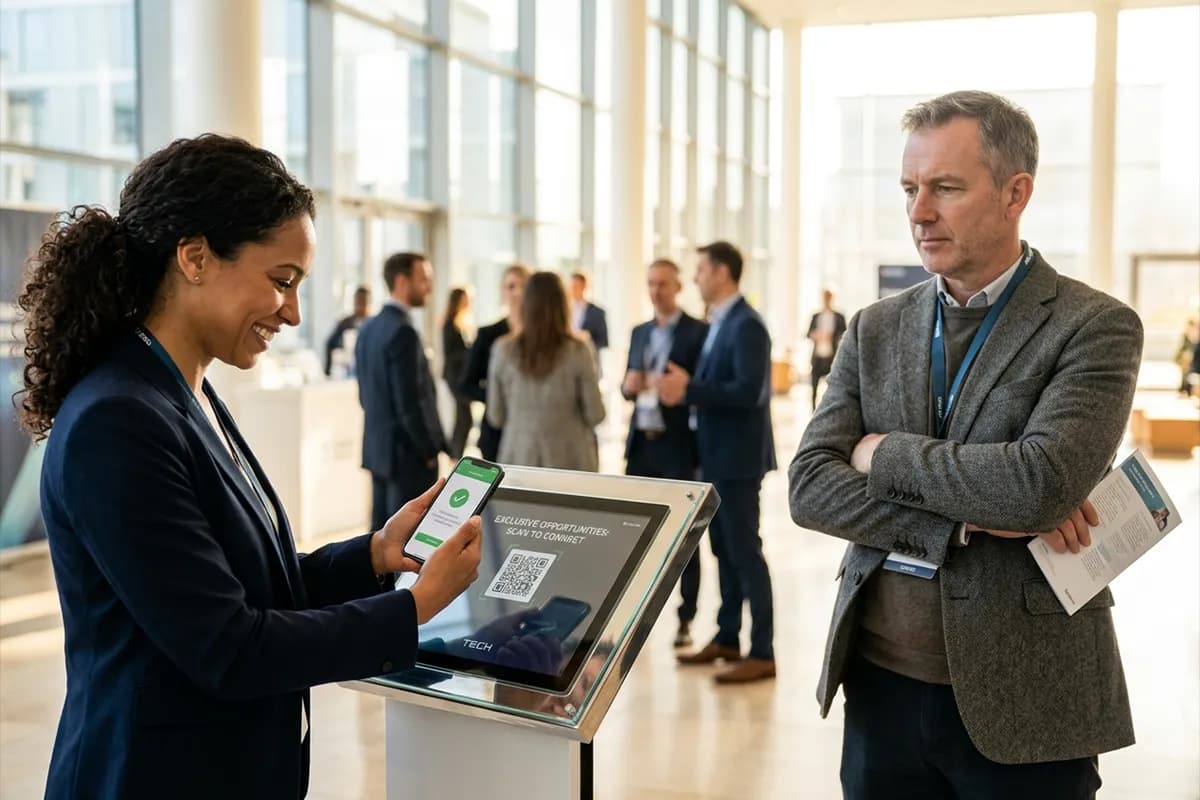
Platforms like Cardixx are built specifically for this moment. When you arrive at an event or conference, you check in through the app and set your networking intent. You can immediately see other professionals who have also checked in, their names, titles, companies, and what they are there for. You can send a message before you even approach someone. And when you meet in person, you exchange digital business cards through a simple QR code scan, with full professional profiles on both sides.
This single layer of visibility changes everything. Instead of wandering the room hoping to stumble into a relevant conversation, you walk in knowing who is there and why. The interaction becomes intentional rather than accidental.
Beyond Cardixx, CRM-integrated tools like Mobilo and Blinq also help professionals manage connections made at events by linking card exchanges directly to contact management systems. For teams attending conferences together, these tools provide a shared log of every connection made, which makes post-event follow-up far more organised than a pile of paper cards or a list of LinkedIn requests with no context attached.
The right tools do not replace the human element of networking. They protect it. They make sure the conversations you have in person are not lost the moment you walk out the door.
Strategies to Build Stronger Relationships at Events
The quality of a connection made at a business event depends almost entirely on the quality of the conversation that created it. And most networking conversations are weak because people talk about themselves too much and listen too little.
The professionals who build the strongest relationships at events are the ones who ask better questions. Not "what do you do?" but "what are you working on right now that is exciting you?" Not "who do you work for?" but "what problem are you trying to solve?" These questions open conversations rather than closing them. They invite stories rather than summaries.
And stories are what people remember. You will forget someone's job title within twenty minutes of meeting them. You will remember the problem they described, the challenge they are navigating, the thing they said that surprised you. When you reach out to follow up three days later, you will have something real to reference. That reference is what makes the follow-up feel personal rather than transactional.
Building stronger relationships at events also means being genuinely present. Not checking your phone between conversations. Not scanning the room over someone's shoulder for a more important person to talk to. The person in front of you chose to spend their time talking to you. Treat that like it matters, because it does.
Tracking and Maintaining Contacts After Events
Everything you did at the event, the preparation, the conversations, the cards exchanged, the impressions made, has a shelf life. That shelf life is short. If you do not follow up within 48 hours, the memory of the conversation fades on both sides and the momentum disappears.
Follow up fast and follow up specifically. Reference something real from the conversation. A point they made that stayed with you. A challenge they mentioned that you have a thought on. Something that signals you were actually paying attention and that this is not a generic mass follow-up sent to everyone you spoke to.
This is also why digital business card exchanges matter so much more than LinkedIn connections alone. When you exchange cards digitally through a platform like Cardixx, both of you walk away with each other's complete professional profile, saved and organised. If the other person does not have the app, they can still receive your card as a PDF or JPEG and save your details without losing anything. The contact is clean, complete, and ready to act on.
For ongoing relationship building, treat your network like a living thing that needs attention rather than a database you add names to. Check in with valuable contacts occasionally, not just when you need something. Share something relevant to their work. Congratulate them on something real. The professionals who build the deepest business relationships are not the ones with the most connections. They are the ones who consistently show up for the connections they already have.
Business networking events are full of opportunities. They always have been. The difference in 2026 is that the tools exist to stop leaving those opportunities on the table. The question is no longer whether the right people are in the room. They are. The question is whether you are prepared to find them, connect with them, and do something real with it after you leave.