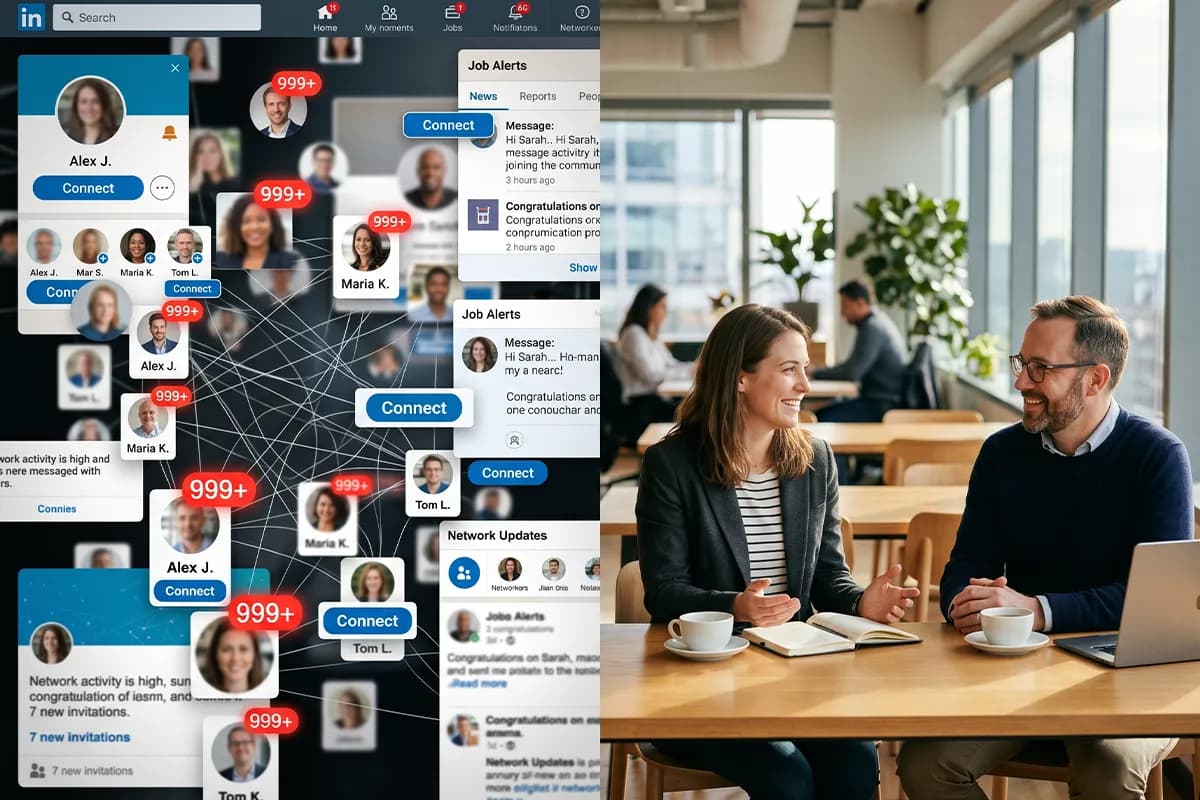

Daniel had 4,200 connections on LinkedIn.
He had spent three years building that number carefully. Thoughtful connection requests, consistent posts, the occasional article that got decent engagement. On paper, his network looked impressive. In practice, when he needed an introduction to a specific investor, he messaged fourteen people he considered real connections. Two replied. One replied with something useful.
Four thousand connections. Fourteen messages. Two replies.
This is not a story about Daniel doing something wrong. It is a story about what LinkedIn networking strategies are actually built for, and where they quietly run out of road.
What Is LinkedIn Best Used For in Networking?
LinkedIn is genuinely good at a specific set of things, and underestimating those things would be its own mistake. As a discovery tool, it has no real competitor. You can find someone's professional history, understand their current focus, identify mutual connections, and arrive at a first conversation with more context than any previous generation of professionals could have imagined. For online vs offline networking, this asymmetry matters: LinkedIn collapses distance and gives you a starting point where none existed before.
It also works well as a long-term visibility layer. Showing up consistently, sharing ideas, and staying present in a professional community means that when someone relevant comes across your name, they already have a frame for who you are. That is not nothing. That is, in fact, quite valuable. But it is the beginning of a relationship, not the relationship itself. The moment most people mistake the directory for the connection is the moment LinkedIn networking pros and cons start to matter.
What Are the Limitations of LinkedIn Networking?
The core limitation of LinkedIn is structural, not accidental. The platform is designed for broadcasting and discovery, not for the kind of sustained, low-stakes interaction that actually builds trust. You can like someone's post for two years and still not know how they handle disagreement, whether they follow through on small commitments, or what they care about when no one is watching. These things are not visible on a profile. They are only visible over time, in real interaction.
There is also the noise problem. LinkedIn alone is not enough for networking in part because the signal-to-noise ratio has collapsed. Inboxes are full of automated outreach, generic congratulations, and connection requests with immediate pitches attached. In that environment, even genuine messages get lost. The platform has become so crowded with performance that authenticity has become harder to read, and harder to trust. Which raises the question that online vs offline networking pros and cons always eventually lands on: where does trust actually come from?
Why In-Person Networking Builds More Trust
The research on this is consistent and not particularly surprising: face-to-face interaction accelerates trust in ways that digital communication cannot replicate. Part of this is physiological. Eye contact, physical presence, the small social rituals of conversation, these activate trust responses that a screen simply cannot trigger. But part of it is also about stakes. When someone takes the time to be in the same room as you, they have made a commitment with their body, not just their attention. That commitment is legible. It means something.
The benefits of face-to-face networking in business go beyond warmth, though. In-person environments also create a different quality of information. You learn how someone moves through a room, how they treat people who cannot help them, whether they listen or wait to speak. None of this appears on a LinkedIn profile. All of it shapes whether you would trust someone with an introduction, a referral, or a real collaboration. How to build trust through networking is, at its core, a question about presence, and presence is still most legible in person.
How to Combine LinkedIn and Offline Networking Effectively
The most effective professionals in 2026 are not choosing between linkedin vs offline networking. They are using each for what it is actually good at. LinkedIn handles discovery, visibility, and the kind of light-touch maintenance that keeps relationships from going completely cold. In-person environments handle depth, trust, and the kind of conversation that actually moves things forward. A hybrid networking strategy built on this logic is not a compromise. It is a more accurate map of how relationships actually develop.
In practice, this looks like using LinkedIn to identify who will be at an event before you go, or following up a real conversation with a connection request rather than the other way around. It looks like Cardixx, a Vienna-based professional networking platform gaining attention among founders and entrepreneurs, which is designed specifically for this gap: making real-world interactions more intentional by giving you visibility into who is present in a given space and what they are looking for, so that the in-person moment becomes less about chance and more about context. The tool does not replace the conversation. It makes the conversation more likely to be the right one. The best way to use LinkedIn and offline networking together is to treat them as a sequence, not a competition.
What Is the Future of Professional Networking?
The honest answer is that the future looks a lot like the past. The tools are changing. The underlying logic is not. Relationships built on repeated, real interaction have always been more durable than those built on digital signals, and that gap is widening as digital communication becomes more automated and less personal. The trends shaping networking in 2026 point in one direction: the professionals who will build the strongest networks are the ones who use technology to get into the right rooms and then do the work of actually being present once they are there.
Is LinkedIn enough for professional networking? For discovery and visibility, yes. For building relationships that actually hold weight when it matters, no. Daniel eventually got his introduction, not through LinkedIn but through someone he had met twice at a small founder dinner and kept in touch with over six months of occasional, unremarkable messages. Four thousand connections. One dinner. The math is uncomfortable, but it is the right math.