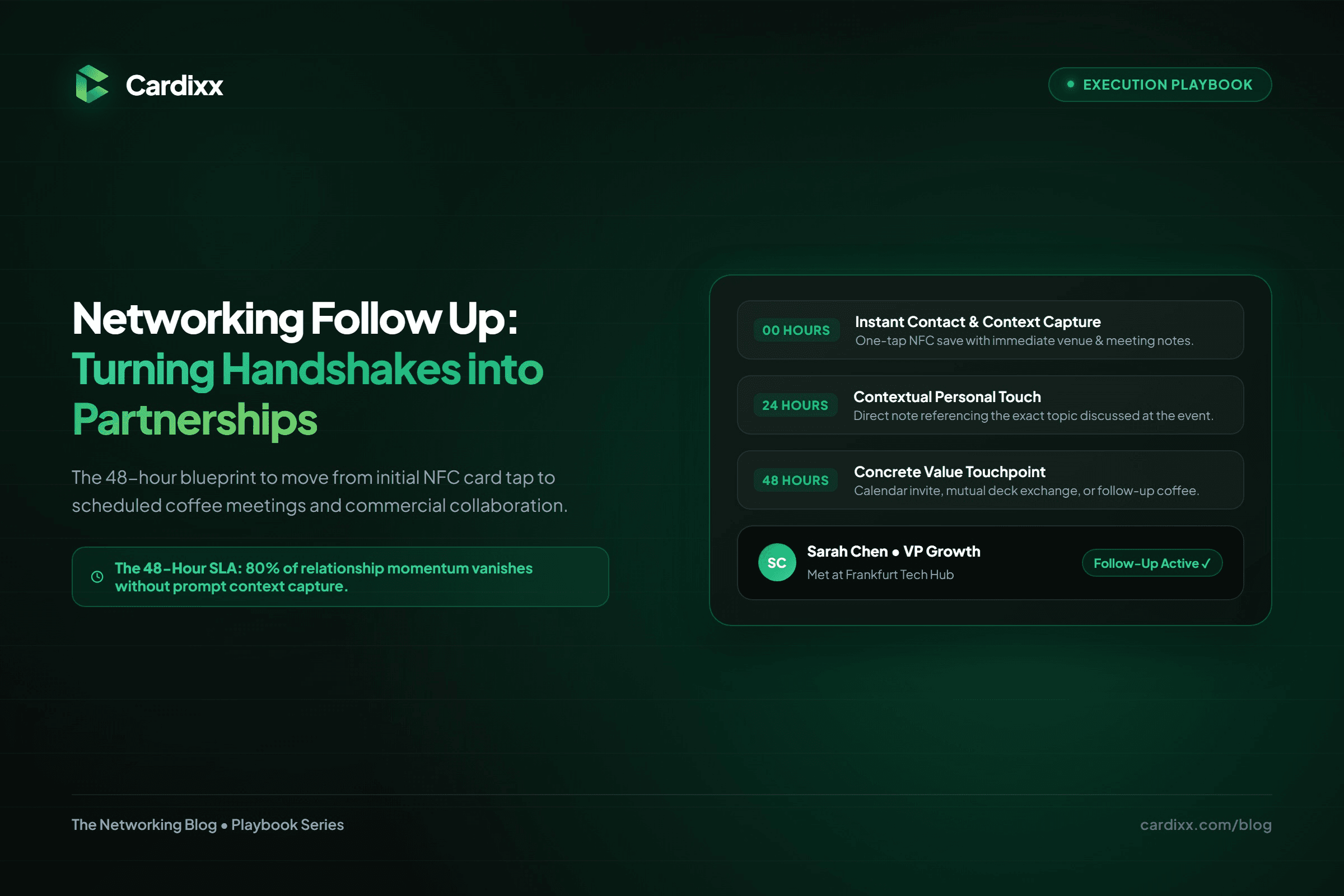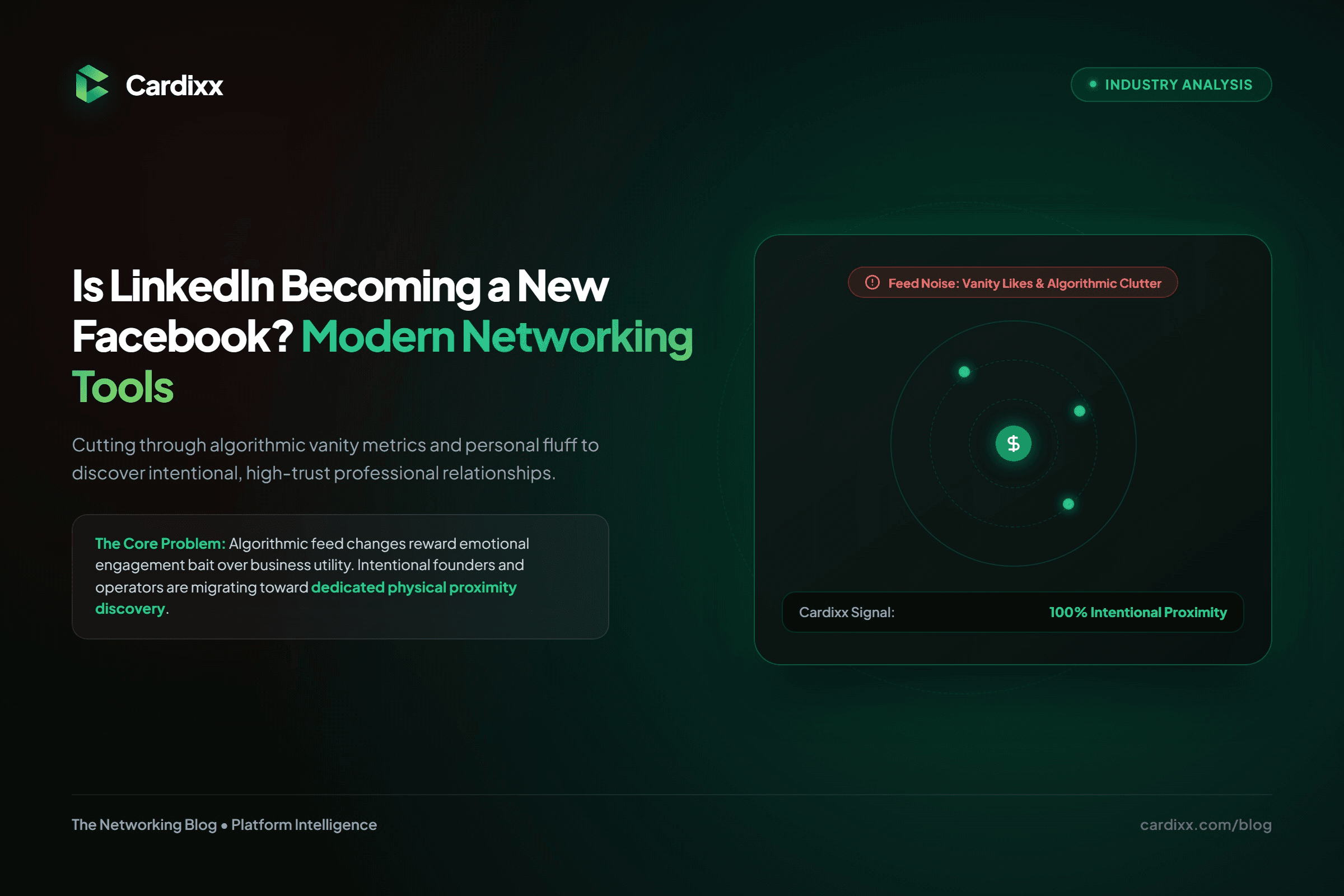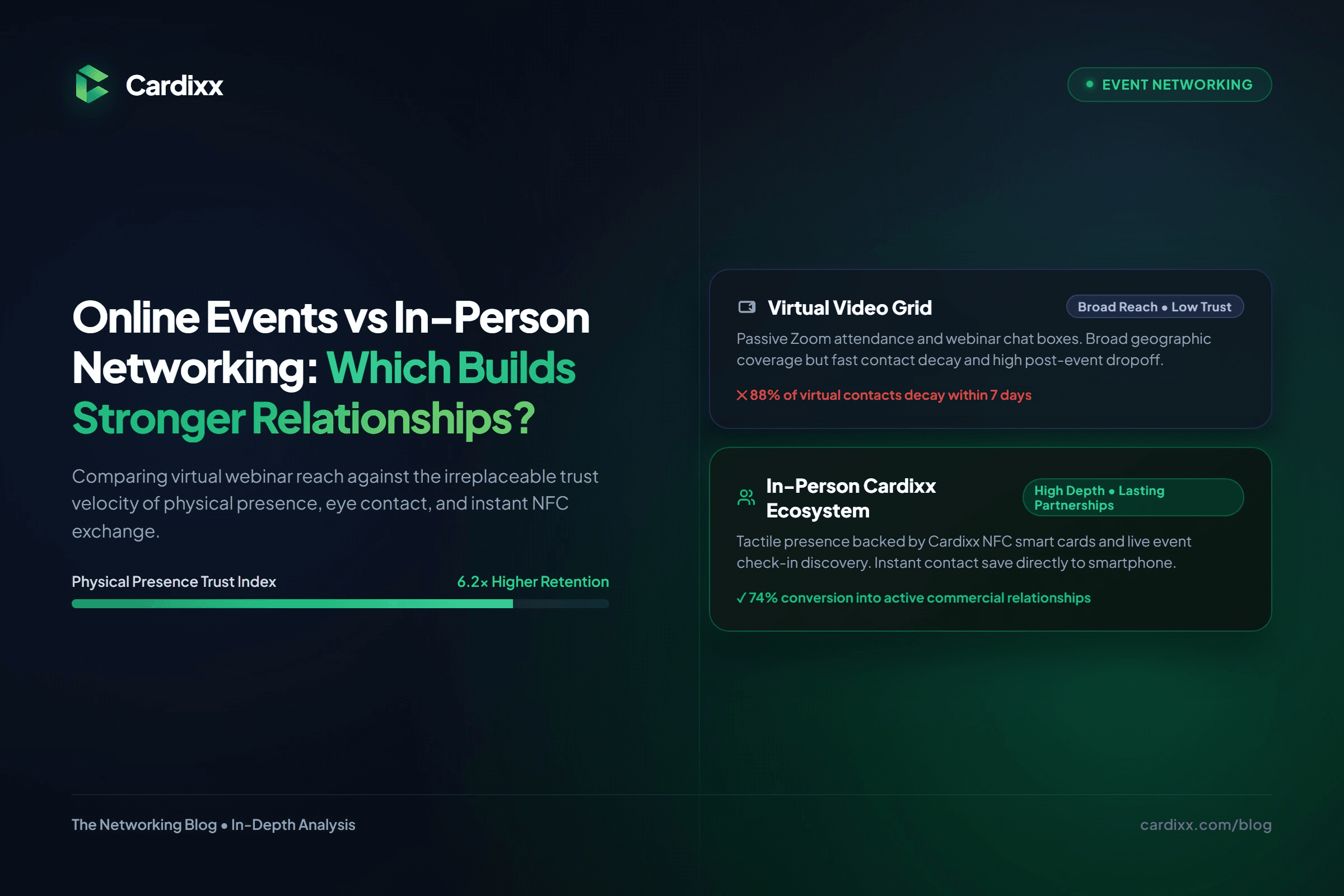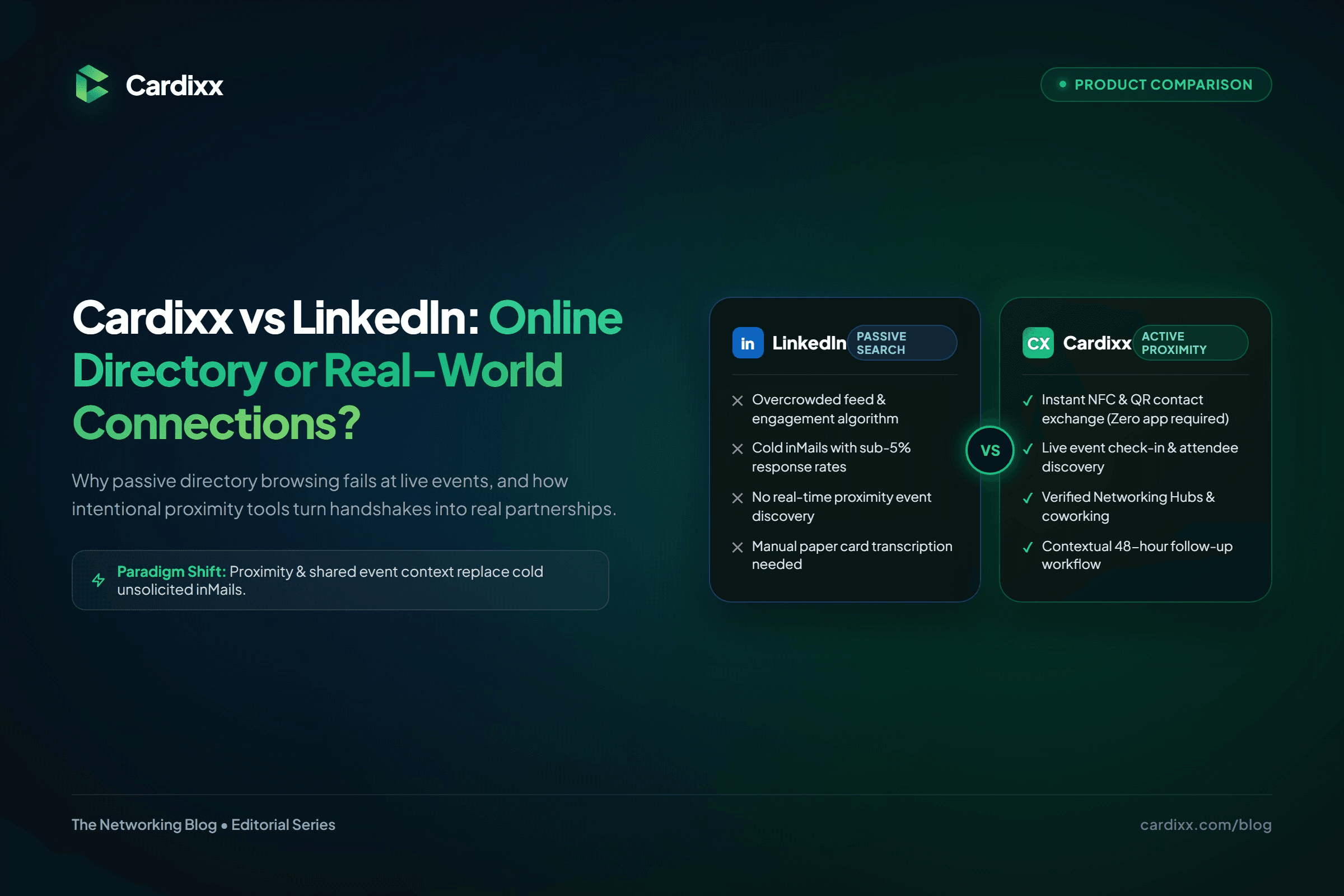

LinkedIn and Cardixx solve different halves of professional networking. LinkedIn is where your professional identity lives online: a searchable profile, a feed, connections, and one of the largest professional networking sites in the world. Cardixx is built for the moment you are actually standing in front of someone: check in, get discovered, exchange a digital business card, and follow up with the context of where you met. One is built for reach. The other is built for the room you are in.
This guide compares what each one is actually good at, where LinkedIn still wins outright, and where a tool built around intentional face-to-face connection picks up what LinkedIn was never designed to do. If you are still weighing the online-versus-in-person question more broadly, see Online Networking Events vs In-Person Networking.
Choose LinkedIn when you want a permanent professional identity, a searchable network, and the ability to reach people you have never met in person. Choose Cardixx when you are physically at an event, a coworking hub, or a meetup and want to know who else there is worth talking to, then turn that conversation into a saved contact with real context.
Most professionals end up using both, because online reach and in-person intent solve different problems.
What each one is built for
Before the detail, here is what each tool is built for, with Cardixx first. LinkedIn is a persistent online identity; Cardixx is built for the room you are in right now.
Dimension | Cardixx | |
|---|---|---|
Core purpose | In-person presence | A persistent online identity |
Findable when | Right now, in this room | Anytime, from anywhere |
The unit | A designed digital business card | A searchable profile |
Scope | The room you are in | A global network |
What LinkedIn actually is
LinkedIn is a persistent professional network. It gives you a searchable profile, connections, direct messaging, company pages, a content feed, and recruiting tools, all built to work whether or not you are ever in the same room as the people you connect with. Asking is LinkedIn social media undersells it a little: it functions as social media, a job board, a publishing platform and a professional networking site at once, and that range is exactly why it dominates online professional networking.
LinkedIn also runs its own event system. LinkedIn Events lets a host set up an online, in-person or hybrid gathering with a dedicated page, an agenda, and a visible attendee list, and the platform recommends events based on your interests and network. For finding out what is happening in your industry from behind a screen, it is hard to beat.
Events: check-in versus LinkedIn Events
Both help with events, but at different stages. The table below compares Cardixx's live check-in with LinkedIn Events, with Cardixx first, so the in-room gap is clear.
Event aspect | Cardixx | |
|---|---|---|
Before the event | Find nearby events on a map | Listings, agenda, attendee list |
Finding the event | Events near where you are | Recommendations by interest |
On arrival | Live check-in and discovery | No in-room layer |
Who is open right now | Shown in real time | Not available |
What Cardixx actually is
Cardixx is not trying to be a second LinkedIn. It is built around the part LinkedIn does not really cover: physical presence. You create a digital business card, front and back, then use it inside a workflow built for real rooms, checking in at a venue or event, seeing who nearby is open to connecting, sending a request, and exchanging your card the moment a conversation is worth continuing.
Where LinkedIn is about being findable at any time from anywhere, Cardixx is about being findable right now, in this room, by the people who are also there and also open to it. It is professional networking scoped to a physical moment instead of an open-ended feed. For the broader version of this distinction, a designed card versus a discovery app, see Digital Business Card vs Networking App.
Cardixx vs LinkedIn, side by side
Here is how the two compare on the factors that actually decide which one helps in a given moment.
Factor | Cardixx | |
|---|---|---|
Best for | Meeting the right people in a physical room | Building a permanent, searchable professional identity |
Reach | Local to wherever you are checked in | Global, works with no physical proximity |
Discovery method | Presence-based, checked-in and nearby | Search, algorithmic feed, recommendations |
The card itself | A designed digital business card, front and back | A profile page, not a shareable business card |
Event support | Live check-in and discovery at the actual event | LinkedIn Events, online, in-person or hybrid listings |
Follow-up context | Tied automatically to where and when you met | Connection notes, manual |
Read across the rows and the split is clear. LinkedIn wins on permanence and reach. Cardixx wins on turning a specific, physical moment into a real connection.
Discovery: how each finds people
Discovery is where the two diverge most. The table below compares how each finds people, with Cardixx first, since presence-based discovery is exactly what LinkedIn cannot do.
Aspect | Cardixx | |
|---|---|---|
Method | Check in and nearby | Search, feed, recommendations |
Signal | Available to connect now | A static profile |
Proximity | Local to your check-in | None needed |
In the room | Shows who nearby is open | Cannot sense presence |
The card and the exchange
The exchange itself works very differently on each. The table below compares the card and the in-person exchange, with Cardixx first.
Aspect | Cardixx | |
|---|---|---|
Shareable card | Designed, front and back | A profile page, not a card |
Share in person | Instant, by QR code | Type a name or scan a link |
Context of exchange | Where and when, saved | A manual connection note |
Follow-up grounding | Tied to the meeting | A generic request |
Where LinkedIn wins
LinkedIn earns its dominance, and a fair comparison has to say so plainly.
Its network is enormous and established. Whatever your industry, the people you want to reach are very likely already there, searchable by name, title or company, whether you have met them or not.
It doubles as your professional record. Recruiters, clients and collaborators check a LinkedIn profile the way they once checked a resume, and that credibility took years to build into the platform.
It works entirely without proximity. You can build a relationship with someone on another continent through messages, content and mutual connections, something a presence-based tool by definition cannot do.
Where LinkedIn wins
LinkedIn earns its dominance, and a fair comparison says so plainly. The table below sums up where LinkedIn wins outright.
LinkedIn strength | Why it matters |
|---|---|
Network size | The people you want are likely already there |
Professional record | Recruiters and clients check it like a resume |
Works without proximity | Build ties across any distance |
Where intentional face-to-face connections win
For the relationships that start in a real room, Cardixx is built for exactly that moment in a way a general-purpose network is not.
It knows you are actually there. Checking in at a venue or event is a live signal, available to network now, which a static LinkedIn profile cannot express.
It shows you who else is open to it, nearby, right now, instead of leaving you to scan a crowded room and guess who might be worth approaching.
It keeps the context. When you exchange a card through Cardixx, the meeting is tied to where and when it happened, so the follow-up is grounded in something specific, not a generic connection request. You can use Cardixx for real world networking the next time you are actually in the room and want the people around you to matter as much as the ones you can reach online.
Where intentional face-to-face wins
For relationships that start in a real room, Cardixx is built for exactly that moment. The table below captures where face-to-face wins.
Face-to-face strength | Why it matters |
|---|---|
Knows you are there | A live available to network now signal |
Shows who is open | No scanning a crowded room and guessing |
Keeps the context | Follow-up grounded in where you met |
Finding professional networking events, on LinkedIn and in person
The two also complement each other at the discovery stage. LinkedIn Events surfaces professional networking events near me style listings well before you leave the house, and browsing professional networking groups near me on the platform is a reasonable way to find communities worth joining.
The gap opens once you actually arrive. LinkedIn can tell you an event exists. It cannot tell you, once you are standing in the room, which of the forty people around you are open to a conversation right now. That is the specific gap Cardixx closes.
Which tool for which task
Used together, each tool has tasks it owns. The table below matches the task to the better tool and why, so you do not force one to do the other's job.
Task | Best tool | Why |
|---|---|---|
Research who will be in the room | Searchable profiles before you go | |
Get discovered at the event | Cardixx | Live check-in signals presence |
Exchange a card in person | Cardixx | Designed, instant, context saved |
Keep a professional record | A persistent searchable identity | |
Follow up with context | Cardixx | Tied to where and when you met |
Using Cardixx and LinkedIn together
Treated as competitors, the comparison is unfair to both. LinkedIn was never built to sense physical presence, and Cardixx was never built to be a searchable global professional identity. Used together, LinkedIn is where you research a room before you walk into it, and Cardixx is what turns the walk into a relationship, then hands you a saved contact with the context intact.
Be honest about the trade. Cardixx does not compete with LinkedIn's scale, its recruiting ecosystem, or its role as a professional record. If that is what you need, LinkedIn remains the tool. If your gap is what happens after you walk into the room, that is what Cardixx is for.
Which one builds more intentional connections?
Choose LinkedIn if your goal is a searchable professional identity and the ability to reach people anywhere, regardless of whether you ever meet in person. Choose Cardixx if your goal is making the most of the room you are actually standing in, meeting the right people rather than a random few, and keeping the context once you do.
For most professionals, the two are not a choice at all. LinkedIn builds the network. Cardixx builds the moment.
Which to choose, by goal
The honest answer for most people is both. The table below turns each goal into a best fit, so you can pick the right tool for what you are actually trying to do.
Your goal | Best fit | Why |
|---|---|---|
A permanent, searchable identity | Reach and a lasting record | |
Reach people you have not met | A global network | |
Meeting the right people in a room | Cardixx | Presence-based discovery |
Keeping context after you meet | Cardixx | Automatic meeting context |
Finding a new job | Recruiter visibility |
Frequently asked questions
Q: Is Cardixx a replacement for LinkedIn?
No. LinkedIn is a persistent, searchable professional network built for reach across any distance. Cardixx is built for physical presence, checking in at events and venues to find and connect with people who are actually there.
Q: Can I use LinkedIn Events and Cardixx together?
Yes. LinkedIn Events is a strong way to discover what is happening and who might attend before you go. Cardixx picks up once you are physically at the event, showing who nearby is open to connecting in real time.
Q: Why not just exchange LinkedIn profiles in person?
You can, but it usually means typing a name into search or scanning a generic profile link with no context. A Cardixx digital business card is designed to be shared instantly in person and keeps a record of where and when the exchange happened.
Q: Does Cardixx have the same network size as LinkedIn?
No, and it is not trying to. Cardixx is newer and scoped to real-world presence rather than a global searchable directory. Its value is depth and context in a specific room, not the breadth of LinkedIn's network.
Q: Which is better for finding a new job?
LinkedIn remains the stronger tool for job search, recruiter visibility and building a professional record. Cardixx is better suited to making real connections count once you are already at an event, conference or coworking space.
Ready to make the room count? Download Cardixx on the App Store, get it on Google Play, or see Cardixx for events on the web and turn face-to-face meetings into relationships that last.