
The meeting is not the finish line, even though it feels that way in the moment. A genuinely good conversation at an event, a coworking space, or a business networking events near me mixer can still amount to nothing if the follow-up never happens, or happens too late, or happens with nothing specific to say. Most networking value is not lost in the room. It is lost in the days after, quietly, in the gap between a real connection and a message that never gets sent.
This guide covers how to close that gap: when to follow up, what to actually say, and how to keep enough context that the follow-up is even possible in the first place.
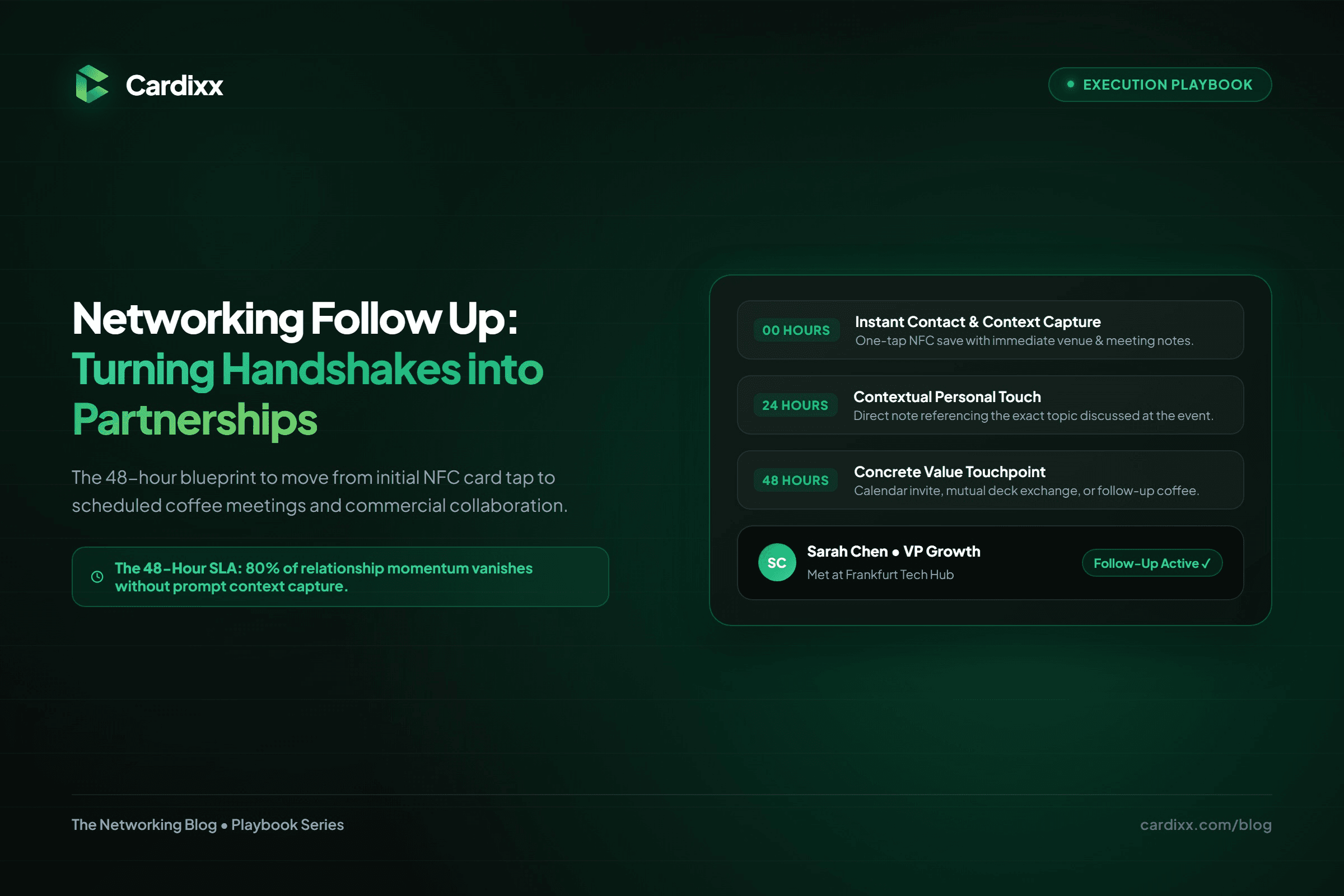
Follow up within 48 hours, referencing something specific from the conversation, not a generic reconnection line. The biggest predictor of whether a new contact becomes a real relationship is not how good the initial conversation was, it is whether anyone actually followed up, and how quickly. Most networking effort, and most professional networking definition advice, focuses on the meeting itself. The higher-leverage fix is almost always in the follow-up that comes after.
The follow-up window at a glance
Timing is the single biggest factor in whether a follow-up lands. The table below shows how quickly the context fades and what it means for your message.
Time since meeting | What the other person remembers | What that means for your message |
|---|---|---|
Within 24 hours | Face, name, main topic, next step | A short, direct message wins |
24 to 48 hours | Face and main topic | Reference something specific to reconnect |
3 to 7 days | Vague sense of a good conversation | Needs a stronger memory cue |
1 to 2 weeks | Name only, if that | Feels like a reintroduction |
More than 2 weeks | Often nothing | Higher risk of no reply |
Why follow-up is where most networking value is lost
A connection made and never followed up on is functionally closer to a stranger than a contact, whatever a saved business card or a linkedin connections list suggests. The conversation itself is the easy part, most people are capable of a decent exchange in the moment, whether it happens at a large conference or a smaller local networking events near me meetup. The follow-up requires remembering to do it, remembering what to say, and doing it before the context fades, which is precisely where most networking effort quietly stops. For the earlier step in the room, see finding professionals nearby.
The follow-up window: timing matters more than wording
Reaching out within 48 hours, while the conversation is still fresh for both people, matters more than crafting a perfect message. A follow-up sent a week later, however well written, arrives after the context has already started to fade on the other end. Speed beats polish here, a short, timely message outperforms a long, delayed one almost every time.
Writing a follow-up that actually gets a reply
A follow-up that lands has a few consistent parts. The table below breaks down what to include, what to skip, and why each part matters, so the message reads as a real connection rather than a template.
Part of the message | Include | Skip |
|---|---|---|
Opener | One specific reference to the conversation | Great to meet you |
Reason | Why you are reaching out now | A vague reconnect line |
The ask | One clear, small next step | A three-part pitch |
Length | Around three to five sentences | A long summary |
Sign off | A concrete follow-up if they say yes | Let me know if useful |
What to actually say
Reference something specific, the actual topic discussed, a detail about their work, the thing you agreed to send or do next. A generic connection request or a plain great meeting you message reads as a template because it could have been sent to anyone. A follow-up that could only have been written to that specific person, about that specific conversation, is the difference that actually gets a real response.
Choose the right channel
Not every follow-up should land in the same inbox. The table below matches the setting where you met to the channel most likely to reach the person.
Where you met | Best channel | Why |
|---|---|---|
Business networking events | Email or messaging app | Matches how the industry works |
Coworking space or hub | In-app message or direct chat | People are already there |
Conference booth | Email with the deck or link | Ties the ask to a shared moment |
Local networking events near me | Whatever they mentioned using | Their platform, their signal |
Young professionals networking group | Group chat or LinkedIn | Where the group already talks |
The real bottleneck: remembering who, why and what
Context to save | Why it matters |
|---|---|
Where you met | Grounds the follow-up in a real, shared moment |
When | Helps you gauge whether you are still inside the useful follow-up window |
Why you connected | The actual reason worth referencing in the message |
What was discussed | The specific detail that makes the message feel personal, not generic |
The agreed next step | What you actually promised to do, the easiest thing to follow up on directly |
Without this context saved somewhere, even a genuinely good conversation becomes hard to follow up on well within a day or two, since most of it is already fading from memory by the time you sit down to write the message.
From one message to an actual relationship
A single follow-up message is a start, not the finish. Real relationships need a second and third touchpoint over the following weeks, a relevant article shared, an introduction made, a genuine check-in with no ask attached. Professional networking events and conferences produce plenty of first conversations, and so do smaller professional networking groups near me gatherings and free digital business card exchanges at a booth. What separates the people who build an actual network is whether they keep the thread going past that first message.
Manage follow up with Cardixx
This is exactly the gap Cardixx is built to close. When you exchange a digital business card app profile through Cardixx, the location and timing of the exchange are saved automatically, and you can add a note capturing what was discussed, a promised introduction, or the next step you agreed on. The in-app conversation stays available afterward, so continuing the relationship does not mean searching across email, messages and a stack of saved contacts trying to remember who someone was.
Be honest about the trade. Cardixx cannot write the follow-up message for you or make you send it on time. What it removes is the memory problem, so when you do sit down to follow up, the context is already there instead of half-remembered. For the approach that keeps follow-up consent-based, see how to build a network without cold messages.
Frequently asked questions
Q: How soon should I follow up after meeting someone at a networking event?
Within 48 hours, while the conversation is still fresh. A prompt, specific follow-up tends to outperform a more polished message sent a week later, once the context has already started fading for both people, whether you met at a large conference or a smaller professional networking events near me gathering.
Q: What should a good networking follow-up message actually say?
Reference something specific from the conversation, not a generic line. A message that could only have been written to that particular person about that particular exchange gets a real response far more often than a template-style note, or a bare linkedin connections request with no context attached.
Q: Why do so many new contacts never turn into real relationships?
Because the follow-up never happens, or happens too late with nothing specific to say. The conversation itself is rarely the failure point, the days immediately after are, where the context needed for a good follow-up is easy to lose. This applies as much to professional networking sites connections as it does to in-person meetings.
Q: Is one follow-up message enough to build a relationship?
Rarely on its own. A first follow-up opens the door. Real relationships usually need a second and third touchpoint over following weeks, an introduction, a relevant share, a genuine check-in, not just one message and silence.
Q: Can Cardixx help me remember who I met and why?
Yes. Cardixx automatically saves the location and timing of each exchange, and lets you add a note about what was discussed or the agreed next step, so the context needed for a good follow-up is there when you actually sit down to write it.
Q: Does this apply to contacts made through a young professionals networking group too?
Yes, the same principle applies regardless of the setting. A young professionals networking group or a network professional association tends to produce a high volume of first conversations in a short window, which makes a consistent follow-up habit even more important, since it is easy to lose track of who you met without one.
Q: What is professional networking, if not the meeting itself?
A useful professional networking definition centers on ongoing relationships, not single interactions. The meeting starts the relationship. The follow-up, and the ones after it, are what actually build it.
Manage follow up with Cardixx. Download it on the App Store, get it on Google Play, or see it on the web and never lose a good connection to a forgotten follow-up again.