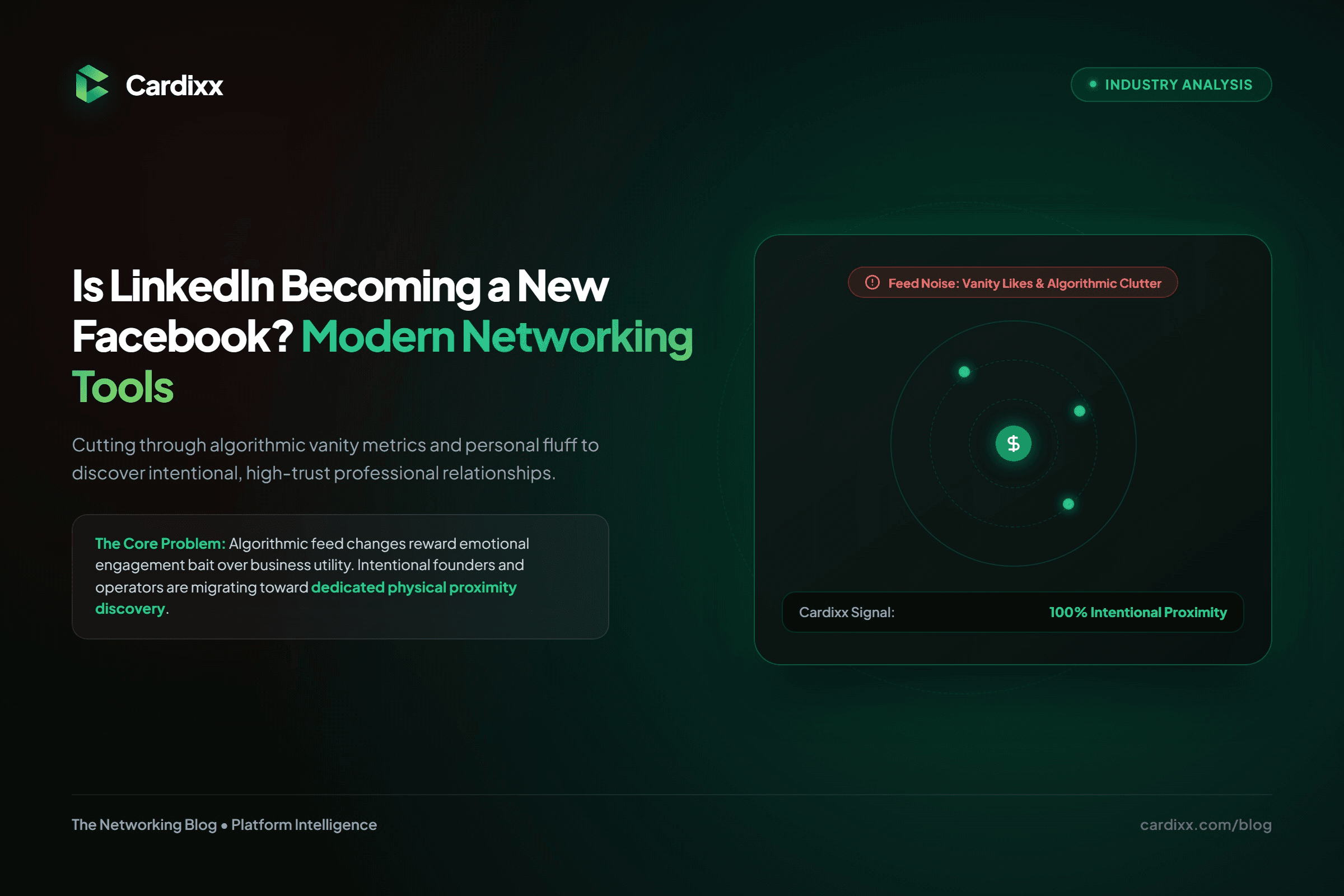

LinkedIn has not turned into Facebook, but its feed increasingly behaves like one: engagement-driven, algorithm-ranked, and full of content designed to be liked and shared rather than read and acted on. The professional core underneath, your profile, your connections, recruiting, has not gone anywhere. What has changed is how much noise sits on top of it before you get to anyone actually useful.
This piece looks at what has actually shifted on LinkedIn, what it still does better than any general social feed, and whether the honest answer to the noise is a new tool, a different approach, or both.
LinkedIn feed then and now
Before comparing tools, it helps to describe what has actually shifted in the LinkedIn experience. The table below sets the older feed against today's, so you can see why professional networking on the platform feels heavier now.
Aspect | LinkedIn feed then | LinkedIn feed now |
|---|---|---|
Ranking | Chronological, from your network | Algorithmic, engagement-based |
Dominant content | Direct updates from connections | Viral posts, personal stories, creators |
Ads and promoted content | Minimal | Sits in the same scroll |
Discovery | Search and profile-first | Feed-first |
Feels like | A professional directory | A social feed |
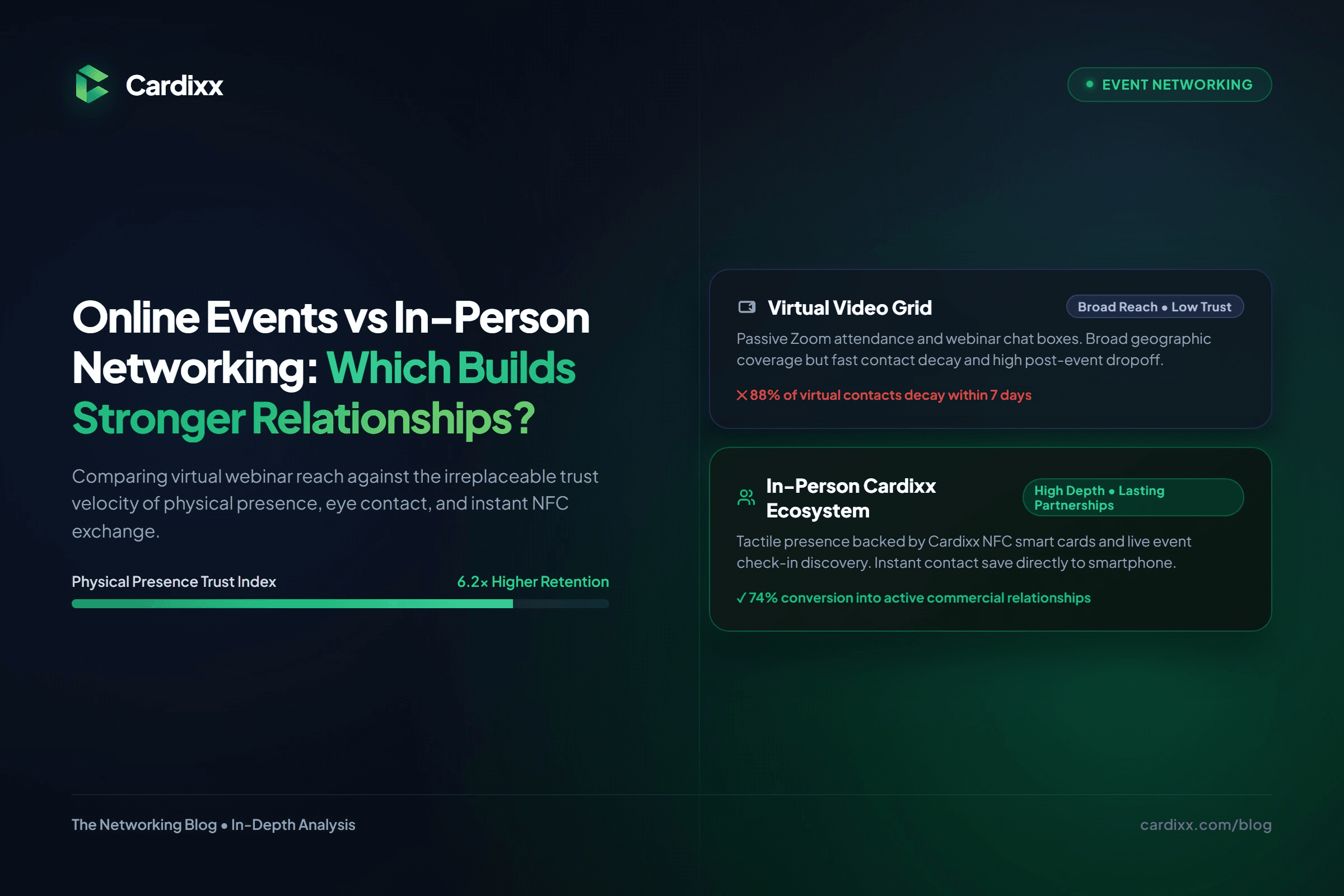
LinkedIn's feed has drifted toward the same engagement mechanics as Facebook and Instagram: algorithmic ranking, viral personal-story posts, and a growing share of ads and creator content. Its professional layer, profile, search, recruiting, messaging, still works and still matters. The real shift is that finding a specific, relevant person to talk to has gotten harder inside the feed, which is pushing more of that work toward more targeted tools and toward real, in-person settings instead, from smaller networking events to local meetups. For that split more broadly, see online networking events vs in-person networking.
Is LinkedIn social media now?
Asking is LinkedIn social media is not a rhetorical question anymore. It has always technically been social media, a network of profiles and connections, but the day-to-day experience used to feel closer to a professional directory than a feed you scroll for entertainment. That has changed. The homepage now runs on the same core mechanic as any social platform: a ranking algorithm that rewards posts for getting reactions, not for being useful to the specific people who see them.
The result is a familiar pattern. Personal, emotional or humble-brag posts about a career milestone tend to outperform a plain, useful update. Creator-style accounts have grown. Sponsored and promoted content sits in the same scroll as posts from people in your actual network. None of this makes LinkedIn Facebook, but the mechanics driving what you see are no longer that different.
LinkedIn versus a social feed like Facebook, on the mechanics
Asking is LinkedIn social media is a fair question because the mechanics have converged. The table below compares LinkedIn and Facebook on how each feed actually works, side by side.
Mechanic | ||
|---|---|---|
Ranking | Engagement-based | Engagement-based |
Rewards | Reactions, comments, shares | Reactions, comments, shares |
Personal story posts | Rewarded | Rewarded |
Ads in the scroll | Yes | Yes |
Underlying identity | Professional profile | Personal profile |
What LinkedIn still does better than any social feed
A fair comparison has to give LinkedIn its due, because the feed is not the whole platform.
It remains one of the strongest professional networking sites for being found. A complete, searchable profile still functions as a professional record that recruiters, clients and collaborators check by default, in a way no purely social platform replicates.
Its structured tools still work as designed. Job search, recruiter outreach, company pages and LinkedIn Events all operate independently of whatever is happening in the feed that day. You can ignore the scroll entirely and still get real value from the platform underneath it.
Where LinkedIn still beats a social feed
A fair reading also has to give LinkedIn its due, because the feed is not the whole platform. The table below lists what LinkedIn still does better than any general social feed and why it matters.
Strength | Why it still matters |
|---|---|
Searchable professional record | Recruiters and clients check it like a resume |
Job search and recruiter tools | Still one of the strongest professional networking sites |
Company pages and LinkedIn Events | Structured tools independent of the feed |
Scale of professionals | Almost every industry, in one place |
It is still where the largest concentration of professionals, across almost every industry, keeps a presence. For pure reach and searchability, no smaller or newer tool matches that scale, and none is trying to.
Why a noisy feed makes professional networking harder
The problem is not that LinkedIn stopped being useful. It is that the useful part now takes more effort to reach. When the feed prioritizes what performs well over what is relevant to you specifically, professional networking on the platform quietly becomes more about being seen than about being introduced to the right person you would meet at business networking events or a coworking space.
That shift matters most at the exact moment networking is supposed to work: when you are trying to find someone specific, at a specific event or in a specific field, and instead you are scrolling past posts optimized for everyone rather than for you.
What the feed cannot do for professional networking
The problem is not that LinkedIn stopped being useful, it is that the useful part now takes more effort to reach. The table below lists what the feed cannot really do for professional networking today, and what actually works better.
What the feed cannot do | What works better |
|---|---|
Find a specific relevant person | Search and message directly |
Show who is at an event with you | A presence-based tool |
Ground a follow up in context | Save where and when you met |
Reach your niche | Smaller professional networking groups near me |
Serve you rather than the algorithm | Structured events and niche communities |
Do we need new tools, or a different approach?
Both, and they are related. Part of the fix is simply behavioral: search and message directly instead of waiting for the feed to surface the right person, join smaller or niche professional networking groups near me instead of the open firehose, and treat LinkedIn as a directory to search rather than a feed to read.
The other part is structural. Some of what LinkedIn's feed has gotten worse at, helping you find and connect with the specific people around you right now, was never something a global feed was built to do well in the first place. That gap is exactly what presence-based tools like Cardixx are built for: instead of competing with LinkedIn's scale, they focus on the people actually near you, at an event, a coworking hub, or a meetup, and skip the feed entirely.
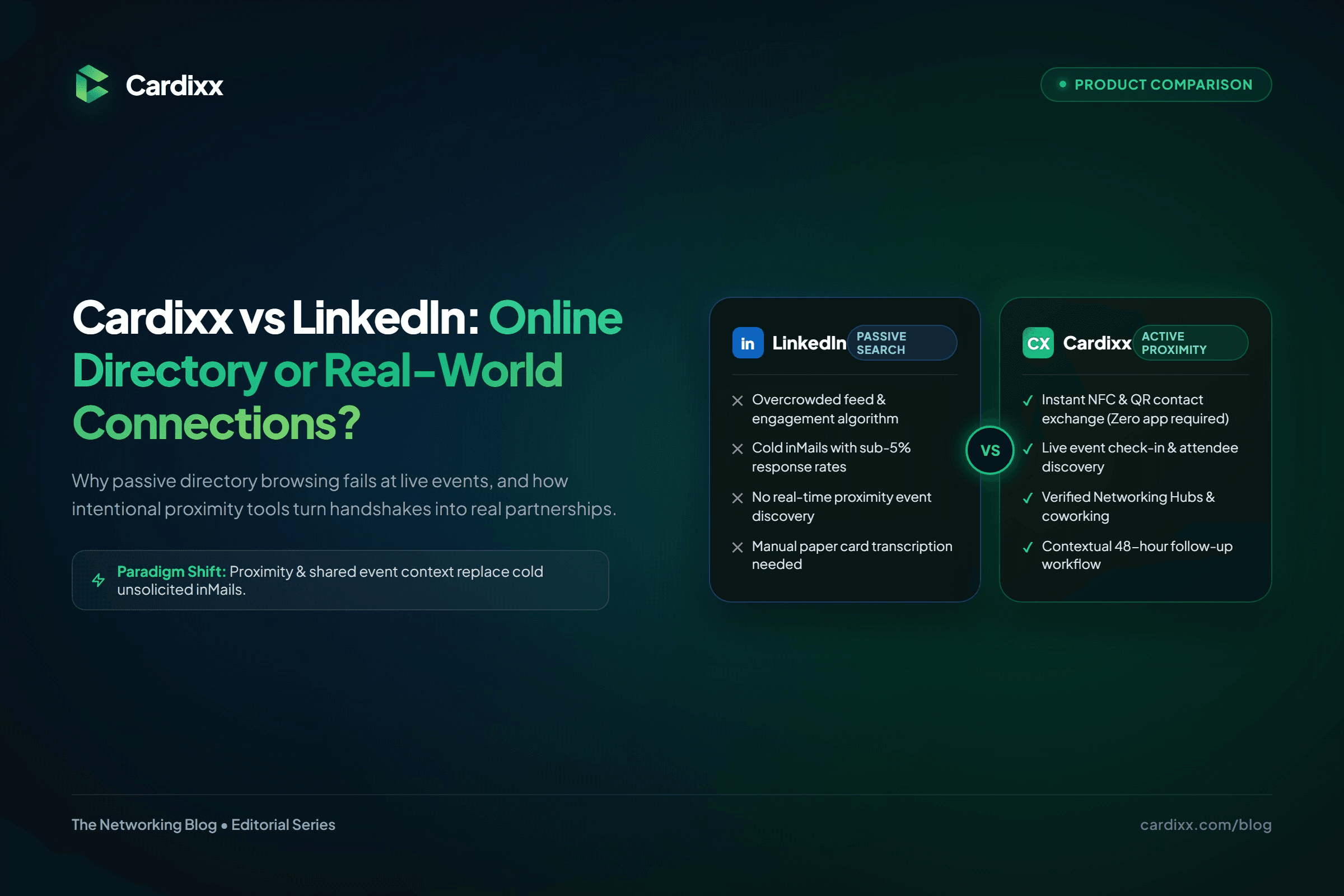
You check in at the venue or event, see who nearby is open to connecting, send a request, and exchange a digital business card once the conversation is worth continuing, with the meeting context saved automatically. It does not replace LinkedIn's searchability or its professional record. It replaces the part of networking that a feed, algorithmic or not, was never well suited to: knowing who is actually around you right now. For a closer look at how the two compare directly, see Cardixx vs LinkedIn.
So, do you still need LinkedIn?
Yes, for the parts a feed cannot replace: a searchable professional record, recruiter visibility, and reach into networks you would never otherwise touch. What is worth dropping is the assumption that scrolling the homepage counts as networking. Search with intent, message directly, and treat structured events and niche groups as the better path through the platform.
For everything that happens once you are actually in a room with real people, a conference, a coworking space, a local meetup, or the professional networking events near me you already attend, a feed was never the right tool to begin with, LinkedIn's or anyone else's. That is where a presence-based approach picks up the slack.
A different approach, tool by moment
The honest fix is both a different approach and, in some moments, a different tool. The table below matches the moment to the right tool, so you can use LinkedIn where it still wins and use a presence-based tool where a feed was never going to.
Moment | Best tool | Why |
|---|---|---|
Being found over time | LinkedIn profile | A searchable professional record |
Job search | Recruiter reach and structure | |
Discovering events | LinkedIn Events | Listings and recommendations |
Meeting people at the event | Cardixx | Live check-in and nearby discovery |
Following up after | Cardixx | Meeting context saved automatically |
Reaching a niche | Smaller professional groups | Signal-to-noise beats the open feed |
Frequently asked questions
Q: Is LinkedIn actually becoming like Facebook?
Not in identity, but in mechanics. LinkedIn's feed now runs on the same engagement-driven ranking as Facebook and Instagram, which rewards viral, emotional posts over useful ones. The underlying professional tools, profile, search, recruiting, remain distinct from a general social feed.
Q: Should I stop using LinkedIn for networking?
No. LinkedIn is still one of the strongest professional networking sites for being found and for structured tools like job search and company pages. The shift is in how much you should rely on the open feed specifically, versus searching and messaging with intent.
Q: What is a good alternative to scrolling the LinkedIn feed?
Search and message people directly instead of waiting for the algorithm to surface them, join smaller niche professional groups, and for in-person settings, use a tool built around presence, like checking in at an event to see who nearby is open to connecting.
Q: Does a tool like Cardixx replace LinkedIn?
No. Cardixx is built for physical presence, checking in and connecting with people actually near you at an event or venue. LinkedIn remains the stronger tool for a searchable professional record and reach across any distance.
Q: Why does LinkedIn's feed favor viral posts over useful ones?
Like most modern feeds, it ranks content by predicted engagement, reactions, comments and shares, rather than relevance to your specific goals. That mechanic favors emotional or broadly relatable posts over a plain, useful update meant for a narrower audience.
Tired of networking through a feed? Download Cardixx on the App Store, get it on Google Play, or see Cardixx on the web and meet the people actually around you.