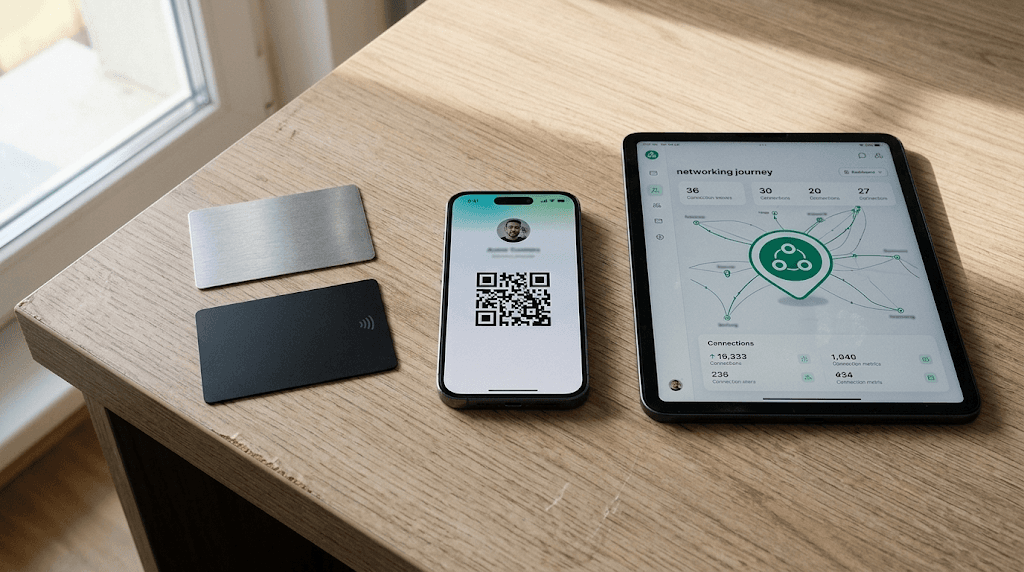

Evaluating the best digital business cards in 2026 comes down to three moments: how you prepare before an introduction, how smoothly you share during an exchange, and how effectively you follow up after the contact is saved. What separates them is what happens before the share, during the exchange, and after the contact is saved. Most of them also offer a free digital business card app to start, so you can test the experience before you pay for anything. That is the lens this guide uses: not just how neatly an app hands over your details, but how far it carries you through the rest of a real networking relationship.
The digital business card app market has split into two broad styles. One group leans on a smart business card nfc device you tap against a phone, and treats the card as a premium physical object. The other group leans on a qr code business card and a link, with nothing to buy or carry. Below we place six of the most talked-about tools side by side, show where each one wins, and then look at what a card can do once the exchange is over.
If you are still deciding what a digital card even is, or how digital business cards work in the first place, start with our digital business card guide for the foundations, then come back here to compare the apps.
The six apps at a glance
Here is the short version before we go deeper on each one. Read it as a starting map, not a verdict, because the right pick depends entirely on how you meet people.
App | Best for | Main sharing method | Free tier |
|---|---|---|---|
Cardixx | The full networking journey | QR code + link | Yes, free to start |
Blinq | Teams and free users | QR, link, NFC, Wallet | Yes, generous |
HiHello | Polished individual cards | QR, link, NFC, Wallet | Yes |
Popl | Event lead capture | QR + NFC tap | Limited |
Linq | NFC with automation | NFC tap + QR | Limited |
Mobilo | Premium sales teams | Premium NFC tap | No free tier |
What to look for in a digital business card app
Before the brand names, decide what you actually need. Four questions sort most of the field. First, do you want to share by qr business card and link, or do you want the feel of a smart digital business card you tap in person? Second, is there a free digital business card you can start with, or does the app expect you to buy hardware first? Third, once you have someone's details, does the app help you follow up, or does it stop at the save? Fourth, can you see any digital business card design and analytics, so you know whether your networking is actually working?
Most apps answer the first two questions well and go quiet on the last two. That is the pattern worth watching as you read on.
Sharing method and hardware, compared
App | Primary sharing | NFC hardware | Cost to start |
|---|---|---|---|
Cardixx | QR code business card + link | None (no NFC hardware) | Free to start |
Blinq | QR, link, Wallet | Optional NFC cards | Free tier |
HiHello | QR, link, Wallet, social | Optional NFC cards | Free tier |
Popl | QR + NFC tap | Tap device you buy | Paid device |
Linq | NFC tap + QR | Tap card or band | Paid |
Mobilo | Premium NFC tap | Premium card required | Paid, no free tier |
Physical NFC cards add an average of 30 to 60 in upfront hardware costs per employee, along with an annual 15% card loss rate during regular travel and conferences.
Blinq: best for teams and free users
Blinq is the app to beat for teams and for anyone who wants a strong free plan. It offers a generous free tier, and its paid plans add team management, branding control and wide CRM integrations with tools like Salesforce and HubSpot. Cards share by qr code business card, link, NFC card products, Apple Wallet and Google Wallet, and the person receiving your card does not need the Blinq app to save it. If you run a sales team that lives in a CRM, Blinq is built for exactly that.
For professionals seeking a Blinq alternative that extends beyond contact exchange into real-world professional discovery, standalone CRM sync covers only the first step. Blinq is excellent at getting a card into a CRM. It is not trying to help you discover new people to meet in the first place, so the value ends roughly where the contact save ends.
HiHello: best polished experience for individuals
HiHello is one of the smoothest tools for an individual. Onboarding is quick, the digital business card design options are clean, and it handles multiple cards, multimedia and contact management well. Cards share by QR, link, email, text, Wallet, widget, NFC and social media, and again the recipient needs no app. For a freelancer or professional who wants an attractive card with little fuss, HiHello is a strong choice.
Its focus is the card and the contacts around it. Like most tools here, it does the identity exchange well and leaves the finding of new people to you.
Popl: best for event lead capture
Popl helped popularise the nfc business card and remains strong for event-driven networking. It pairs a physical tap device with a digital profile, adds lead-capture forms, and leans into trade shows, booths and networking events with team, representative and regional analytics. If most of your networking happens at events and you like a smart business card nfc device, Popl fits that style and turns introductions into structured lead data. Digital lead capture reduces contact-to-CRM processing time from an industry average of 4.2 days down to under 4 minutes, preventing post-event lead decay.
Those evaluating a Popl alternative for trade show lead capture often look for app-free digital wallet passes that avoid physical hardware shipping delays and replacement costs.
Linq: best for NFC with automation
Linq combines NFC sharing with lead automation and creator-friendly features. It suits people who want a business card digital tap plus workflow automations around the leads they capture. The main caution raised by reviewers is cost: its monthly fee can run higher than rivals for similar features, so it is worth comparing plans closely before you commit.
Mobilo: best for premium sales teams
Mobilo positions itself as a lead generation tool first, with premium nfc business cards and a focus on sales-driven teams. If a premium physical object is part of your brand and lead capture is your priority, Mobilo is built for that. It does not offer a free tier, so it aims at teams ready to invest rather than individuals testing the water with a free digital business card.
Free tier comparison
If cost to start is your deciding factor, this is the table to read. A strong free digital business card app lets you prove the idea before you spend anything.
App | Free plan | Key free features | Provider branding on free |
|---|---|---|---|
Cardixx | Yes | Card, QR sharing, check-in, discovery | Minimal |
Blinq | Yes, generous | Multiple cards, wide sharing | None |
HiHello | Yes | Multiple cards, contact management | Some |
Popl | Limited | Basic card profile | Yes |
Linq | Limited | Basic profile | Yes |
Mobilo | No | Not applicable | Not applicable |
Team, CRM and enterprise features
App | Team management | CRM and integrations | Brand controls |
|---|---|---|---|
Cardixx | Networking hubs for venues and events | Contact export | Full card design |
Blinq | Strong team admin, SSO | Salesforce, HubSpot, wide | Yes |
HiHello | Enterprise admin | CRM, Microsoft Entra ID | Yes |
Popl | Team and rep analytics | CRM sync | Yes |
Linq | Team features | CRM + automations | Yes |
Mobilo | Sales-team focused | CRM and lead export | Yes |
Cardixx: best for the full networking journey
Cardixx starts from a different question. The others ask how to share your card better. Cardixx asks what happens after you create a digital business card, and what the card is actually for. Its answer is that any business card has only one real purpose, which is to find people worth exchanging with. Most current solutions stop at creating and sharing the card.
You create a card and share it by business card qr code or link, with no hardware to buy and no smart business card nfc device to carry. Then Cardixx adds the parts most card apps leave out. You can check in at a venue or event to become visible to other professionals nearby, discover people to meet based on profession, interests or intent, send a connection request, chat, and keep the conversation and contact afterwards. Its analytics show views, unique viewers, link clicks, exchanges and views by location, so you can see what your networking is actually producing. This is the connected journey, and it is the thing a rival cannot copy with a single feature update.
Being honest about the trade: Cardixx is newer and earlier in its network than Blinq or HiHello, and it focuses on QR sharing rather than premium NFC hardware. If you want a huge existing user base or a luxury nfc digital business card, another tool may fit better today. If you want the card to be the start of real networking rather than the end of it, that is where Cardixx is built to win.
The networking journey, step by step
This is where the field separates most clearly. Sharing a card is table stakes. What you can do after the share is where the apps stop looking alike.
App | Check-in at venues/events | Discover people nearby | In-app connect and chat | Follow-up |
|---|---|---|---|---|
Cardixx | Yes | Yes, by profession, interest, intent | Yes | Saved contacts + chat |
Blinq | No | No | No | Contact saved |
HiHello | No | No | No | Contact saved |
Popl | Event lead capture | No | No | Lead workflows |
Linq | No | No | No | Lead automations |
Mobilo | No | No | No | Lead capture |
Analytics and measurement
If you want to treat networking like any other channel you measure, check what each app actually reports.
App | Analytics available | What you can see |
|---|---|---|
Cardixx | Yes | Views, unique viewers, link clicks, exchanges, views by location, monthly graph |
Blinq | Yes, on paid plans | Card engagement |
HiHello | Yes | Card and lead analytics |
Popl | Yes | Team, rep, event and regional performance |
Linq | Yes | Lead and automation metrics |
Mobilo | Yes | Lead-generation performance |
Pricing models, without the fine print
Prices change often, so treat the table below as a model of how each app charges rather than a quote. The pattern matters more than the number: QR-first tools tend to be free to start, while NFC-first tools ask you to buy hardware before you begin.
App | How it charges | Hardware to buy |
|---|---|---|
Cardixx | Free to start, QR-based | None |
Blinq | Free tier plus paid plans | Optional NFC |
HiHello | Free tier plus paid plans | Optional NFC |
Popl | Paid device plus plans | Tap device |
Linq | Paid plans, can run higher | Tap hardware |
Mobilo | Paid only, no free tier | Premium card |
How to choose the right one for you
Match the tool to how you actually meet people, not to a feature list.
App | Ideal user | Primary scenario |
|---|---|---|
Cardixx | Anyone who wants to find, connect and follow up | End-to-end networking around one card |
Blinq | CRM-driven teams | Sync contacts into a CRM |
HiHello | Individuals and freelancers | A polished personal card, fast |
Popl | Event and sales reps | Booth and trade-show lead capture |
Linq | Creators and automation fans | Tap-to-share plus workflows |
Mobilo | Premium sales teams | Branded physical lead capture |
Put plainly: choose Blinq if you run a team on a CRM and want the strongest free tier. Choose HiHello if you are an individual who wants a polished card fast. Choose Popl or Linq if NFC tapping at events is central to how you network. Choose Mobilo if a premium physical card and lead capture drive your brand.
Choose Cardixx if you want more than an exchange: to find the right people, connect, and follow up, all around one card. You can compare and try Cardixx for free and see the difference for yourself.
Do you need NFC hardware, or is a QR code enough?
For most people a qr code business card and link are enough, and they cost nothing to start. The best nfc business cards add a premium tap in person and suit heavy event networking, which is where Popl, Linq and Mobilo focus. If you are weighing a tap card against a scan, the table below shows where each app sits.
App | Primary tech | In-person tap | Cost to start |
|---|---|---|---|
Cardixx | QR + link | No, QR or link | Free |
Blinq | QR + optional NFC | Optional | Free tier |
HiHello | QR + optional NFC | Optional | Free tier |
Popl | NFC + QR | Yes | Paid device |
Linq | NFC + QR | Yes | Paid |
Mobilo | NFC, premium | Yes | Paid, no free tier |
If you are still unsure whether to tap or scan, our digital business card vs NFC business card comparison walks through the trade-offs in detail.
Can you switch between apps later?
Yes. Since every app builds on a digital profile, you can move your details to another tool whenever you like. That is a good reason to try a free tier before committing, especially if you want to compare a card-focused tool with a full-journey one like Cardixx. Nothing about starting with an apple digital business card in Wallet or an iphone digital business card locks you in for good.
Frequently asked questions
What is the best digital business card app?
There is no single best digital business card app for everyone. Blinq leads for teams and free users, HiHello for polished individual cards, Popl and Linq for NFC event networking, Mobilo for premium sales teams, and Cardixx for connecting the full networking journey around the card.
Which digital business card app has the best free tier?
Blinq is widely rated as having the most generous free plan, with multiple cards and no provider branding. HiHello and Cardixx also offer strong free options, so the best free digital business card depends on whether you want team features, polish, or a full networking journey.
Do I need an NFC card, or is a QR code enough?
For most people a qr business card and link are enough, and they cost nothing to start. The best nfc business cards add a premium tap in person and suit heavy event networking, which is where Popl, Linq and Mobilo focus. Cardixx works through QR and link without any nfc business card hardware.
What makes Cardixx different from Blinq, HiHello or Popl?
Most apps focus on sharing your card and saving contacts. Cardixx adds the steps around the card: checking in at venues and events, discovering relevant people nearby, connecting, and following up, so the card starts a relationship rather than just an exchange.
How do digital business cards work on an iPhone?
A digital business card qr code or link opens your profile in any browser, so the other person just scans or taps and saves your details. An iphone digital business card can also live in Apple Wallet, but you do not need Wallet or any app for someone to receive your card from a scan.
Can I switch between digital business card apps?
Yes. Since each app builds on a digital profile, you can move your details to another tool at any time. It is worth trying a free tier before committing, especially if you want to compare a card-focused tool with a full networking one like Cardixx.
Want more than a card? Get the full networking journey. Download Cardixx free on the App Store, Google Play, or cardixx.com. |
Written by Cihan Yasa, M.Sc., EMBA