
Event networking breaks down into three separate problems, and most advice only covers the first one. Meeting people is the easy part, any room full of professionals makes that possible. Connecting properly, having a conversation worth remembering, is harder. Following up well, so the connection survives past the parking lot, is where most networking effort actually gets wasted.
This guide covers all three stages in order: how to prepare for and work networking events, how to make a connection that actually means something, and how to follow up so it was not a waste of an evening.
Good event networking has three stages, not one. Before the event, pick a small number of specific goals instead of trying to talk to everyone. During the event, prioritize a few real conversations over a stack of business cards. After the event, follow up within a day or two with something specific from the conversation, or the connection quietly disappears. Most people are decent at stage one and weak at stages two and three, which is exactly where the value actually gets lost.
The three stages of event networking
Good event networking is three jobs, not one, and most advice only covers the first. The table below lays out all three stages of professional networking around an event and the mistake people make at each.
Stage | The job | Common mistake |
|---|---|---|
Meet | Get in front of the right people | Trying to talk to everyone |
Connect | Have a conversation worth remembering | Opening with a pitch |
Follow up | Keep the connection alive after | Meaning to, then never doing it |
What counts as event networking
Event networking covers any professional relationship-building that happens around a shared gathering, a conference, a local meetup, an industry mixer, or a smaller founder or professional group. What separates networking events from a typical work meeting is the structure: attendees are there specifically to meet people they do not already know, which makes the room fundamentally different from a scheduled call with someone already on your calendar.
Before the event: preparing to meet the right people
Walking into networking events with no goal beyond being present is the most common way to leave with nothing useful. A better approach sets two or three specific things to look for, a type of role, a shared interest, a specific problem you want feedback on, so you are filtering the room instead of drifting through it.
Check the guest list or speaker lineup if one is public, and identify a small number of people worth a direct introduction. Arriving with even one specific person in mind changes how the whole event goes, since you are not starting from zero once you walk in.
Before the event: a quick prep checklist
Walking into networking events with no goal is the most common way to leave with nothing. The table below turns preparation into a short checklist, so you filter the room instead of drifting through it.
Prep step | What to do | Why it matters |
|---|---|---|
Set two or three goals | A role, an interest, a problem to solve | You filter the room, not drift |
Check the guest list | Identify a few people worth meeting | Arrive with someone in mind |
Prepare a question | Something genuine to open with | Beats a rehearsed pitch |
Pick the right event | A relevant room over a big one | Focus shapes the conversations |
During the event: meeting people without it feeling forced
The best conversations at networking events rarely start with a pitch. Asking a genuine question, about what someone is working on, why they came, or their take on something happening in the room, tends to open a real conversation faster than an opening line clearly aimed at selling something.
Depth beats volume. Five real conversations you can actually remember by the next morning are worth more than thirty rushed introductions and a pocket full of cards you cannot place a face to. Give a conversation room to breathe before moving on, and it is fine to end one plainly rather than dragging it out once it has run its course.
During the event: do this, not that
The best conversations at professional networking events rarely start with a pitch. The table below pairs what works with what to avoid, so meeting people feels natural rather than forced.
Do this | Instead of | Why it works |
|---|---|---|
Ask a genuine question | Leading with a sales line | Opens a real conversation faster |
Aim for depth | Collecting a stack of cards | Five real talks beat thirty rushed ones |
Let it breathe | Rushing to the next person | Memorable beats numerous |
End plainly when done | Dragging it out | Respects both people's time |
Finding networking events worth attending
Searching business networking events near me or checking local networking events near me listings weekly, rather than relying on a single calendar, surfaces more of what is actually happening nearby. Checking networking events today or networking events this week, instead of a generic monthly calendar, tends to turn up smaller, more relevant gatherings that larger event listings miss entirely.
Quality matters more than quantity here too. A handful of well-chosen, relevant events beats a full calendar of generic ones, since the size and focus of the room directly shapes how many real conversations are possible.
Finding events worth attending
Quality of room beats quantity of events. The table below compares where to look for business networking events near me and beyond, with what each source is best for.
Where to look | Best for | Tip |
|---|---|---|
Local listings | Local networking events near me | Check weekly, not monthly |
This-week searches | Networking events today or this week | Surfaces smaller, relevant rooms |
Coworking space calendars | Regular, low-key meetups | Often already around you |
Event apps and platforms | Larger conferences | Agendas and matchmaking |
Professional groups | Professional networking events near me | Industry-specific rooms |
The follow-up: where most event networking gets wasted
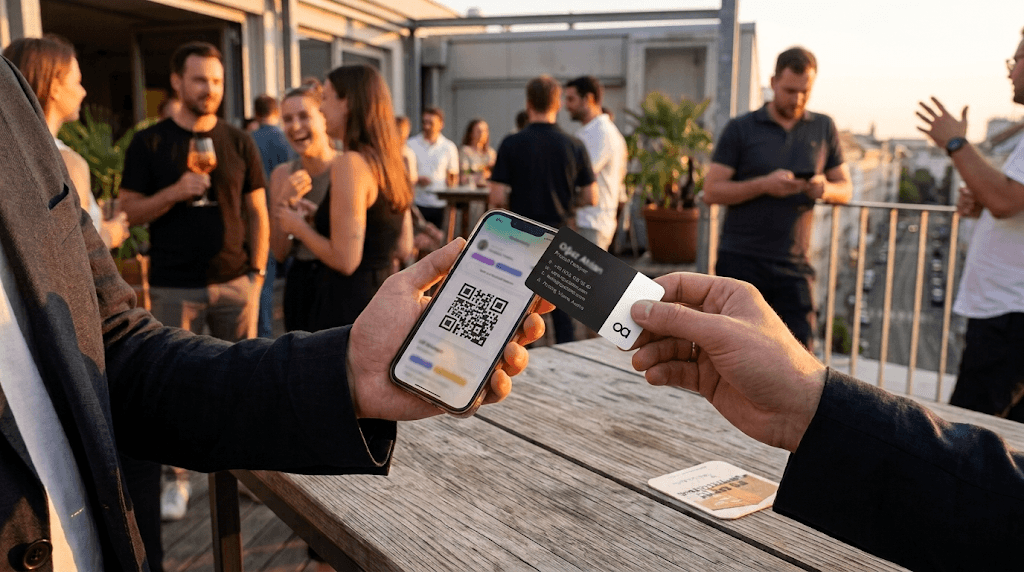
A great conversation with no follow-up is functionally the same as no conversation at all. The single biggest failure point in event networking is not the meeting, it is what happens, or does not happen, in the days after. This is the specific gap Cardixx is built to close. Check in at the event, see who nearby is open to connecting, and exchange a digital business card the moment a conversation is worth continuing, with the context of where and when you met saved automatically instead of relying on memory three days later. Empirical networking studies show that over 80% of business cards exchanged at conferences are thrown away within 7 days. Without immediate contextual note-taking and structured digital follow-ups within 24 to 48 hours, the vast majority of event connections quietly evaporate.
Be honest about the trade. Cardixx does not run the event, manage registration, or replace a genuinely good conversation. What it fixes is the part that quietly kills most networking value: a good exchange that gets lost because nobody remembered to follow up, or remembered why the follow-up mattered.
The follow-up window
A great conversation with no follow-up is the same as no conversation. The table below shows how fast the context fades and what to send, so the connection survives past the parking lot.
When you follow up | What to send | Result |
|---|---|---|
Within 1 to 2 days | A specific reference to your talk | Lands while it is fresh |
3 to 5 days | A stronger memory cue plus a next step | Still works, needs more context |
A week or more | Essentially a reintroduction | Higher risk of no reply |
Never | Nothing | The connection quietly disappears |
Choosing tools to support event networking
Different tools solve different parts of this. Platforms built for large conferences handle registration, agendas and structured matchmaking, covered in detail in Best Event Networking Apps Compared. If you are weighing whether a video call or an in-person event will build a stronger relationship in the first place, see Online Networking Events vs In-Person Networking. This guide focuses specifically on the meet-connect-follow-up sequence that applies regardless of which event or platform you use.
Building event networking into a habit
The people who get real value from networking events treat it as an ongoing practice, not a one-off task before a job search or a fundraise. A short, consistent rhythm, one relevant event every few weeks, a clear goal going in, and a same-week follow-up after, builds a network gradually in a way that occasional bursts of activity never quite manage.
Frequently asked questions
What are the three stages of event networking?
Meeting people, making the connection genuinely count, and following up afterward. Most people focus almost entirely on the first stage, which is also usually the easiest of the three.
How many people should I try to meet at a networking event?
Fewer than you think. Five real conversations you can remember clearly the next day are worth more than thirty rushed introductions you cannot place by name or face a week later.
How soon should I follow up after a networking event?
Within a day or two, while the context is still fresh for both of you. A specific reference to what you discussed makes the follow-up land far better than a generic connection request sent a week later.
Where can I find good networking events near me?
Search business networking events near me and local networking events near me, and check listings weekly rather than relying on one calendar. Checking what is happening today or this week often surfaces smaller, more relevant events that larger listings miss.
What is the biggest mistake people make at networking events?
Treating the event itself as the finish line. The meeting is only the first of three stages, and skipping a genuine follow-up is the most common way a good conversation ends up going nowhere.
Ready to close the follow-up gap? Download Cardixx on the App Store, get it on Google Play, or see it on the web and make your next event count.