
Below is how to do it: where to find people with real context in place, how to make a request feel earned instead of intrusive, and how an opt-in model keeps every request something the other person wants.
Why cold messages fail
You know the message. A stranger lands in your inbox with no note, or a line generic enough to fit anyone. You ignore it, or you accept and never hear from them again. Most of the effort behind that message goes nowhere, because nothing in it gave you a reason to respond.
Cold outreach asks for trust before it has earned any. It treats you as a name on a list rather than a person with a reason to care, so the reply rate stays low no matter how polished the wording is. Networking that works skips this step and builds the reason to connect first.
What consent-based networking actually means
Consent-based networking means both people have some reason to expect the contact before it happens. That reason can be small: you attended the same event, you both checked in at the same venue or coworking space, someone made an introduction, or the other person opted into being visible to people nearby who share their field. Whatever the trigger, the connection starts from something real instead of a cold guess.
This still takes effort on your part. You choose who to approach and what to say. What changes is where you look for people and when you ask: you look for context first, then request contact once that context exists.
Cold message versus a consent-based request
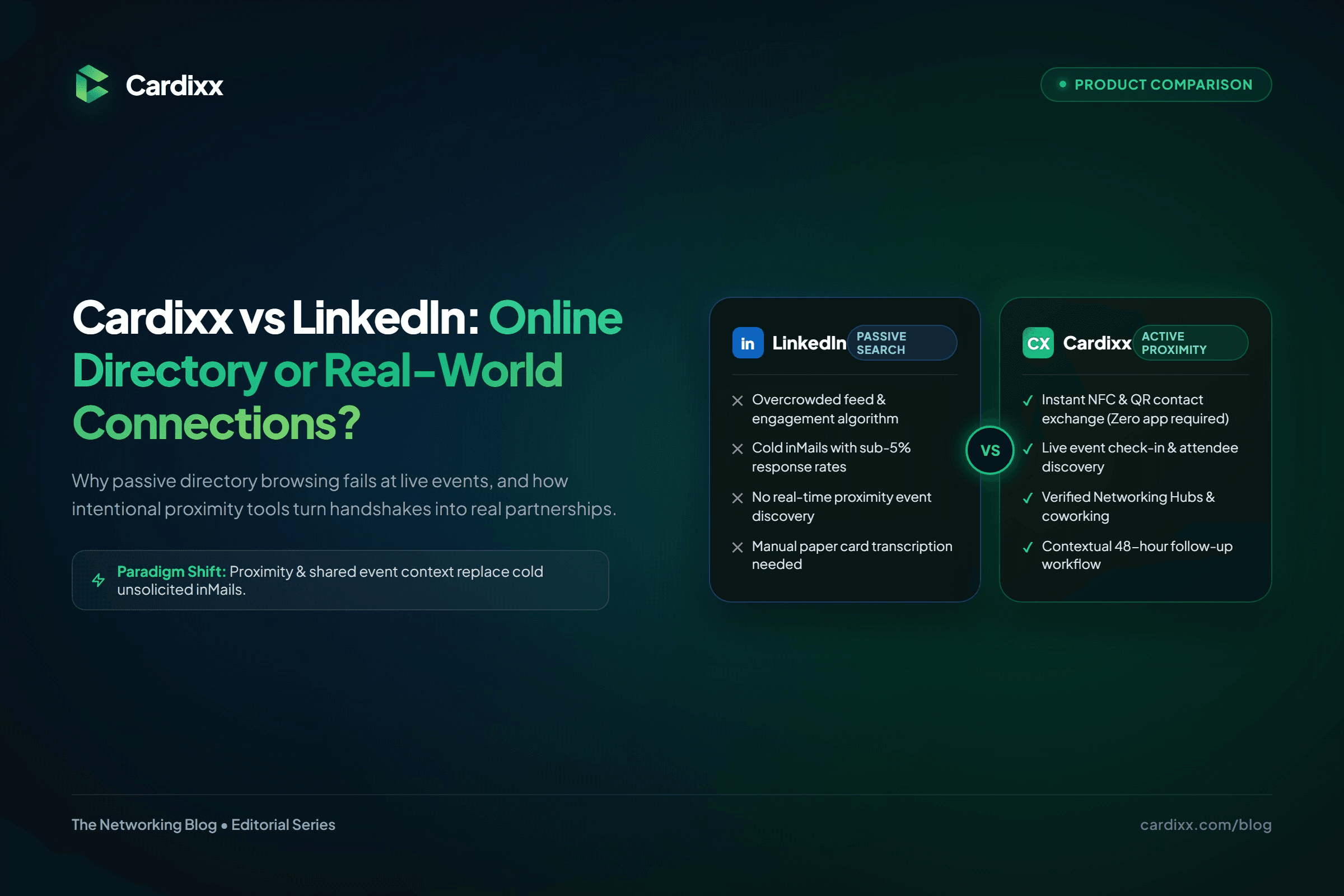
The difference between a cold message and a consent-based request is whether the other person had a reason to expect it. The table below sets the two side by side, so it is clear why context does most of the work.
Aspect | Cold message | Consent-based request |
|---|---|---|
Starting point | A name on a list | A shared event, venue or coworking space |
Reason to reply | None given | Built in from the context |
Reply rate | Low | Far higher |
Effort per reply | High | Low |
How it lands | Intrusive | Earned |
Meet people through shared context first
The easiest way to avoid a cold message is to stop starting from zero. A handful of situations put you and another person on the same footing before either of you says a word.
Situation | Why it works |
|---|---|
A shared event or conference | You have something to reference: the event, a session you both attended |
A check-in at the same venue | You are both there for the same reason at the same time |
A mutual introduction | Someone else has vouched for the connection |
A professional networking group | Membership itself is the shared context |
Business networking events near me are one of the most reliable sources of this kind of context, since everyone in the room opted in to being approached. Professional networking groups near me and professional networking sites work the same way: joining one is a form of consent to be contacted by other members. If your city runs professional networking events on a regular schedule, treat them as a standing invitation rather than a one-off. For more on where to find the right people in the first place, see the professional networking guide.
Let people opt into being found
The strongest version of consent-based networking flips the order. Instead of searching for a person to approach, you let people who want to be found make themselves visible, and you find them.
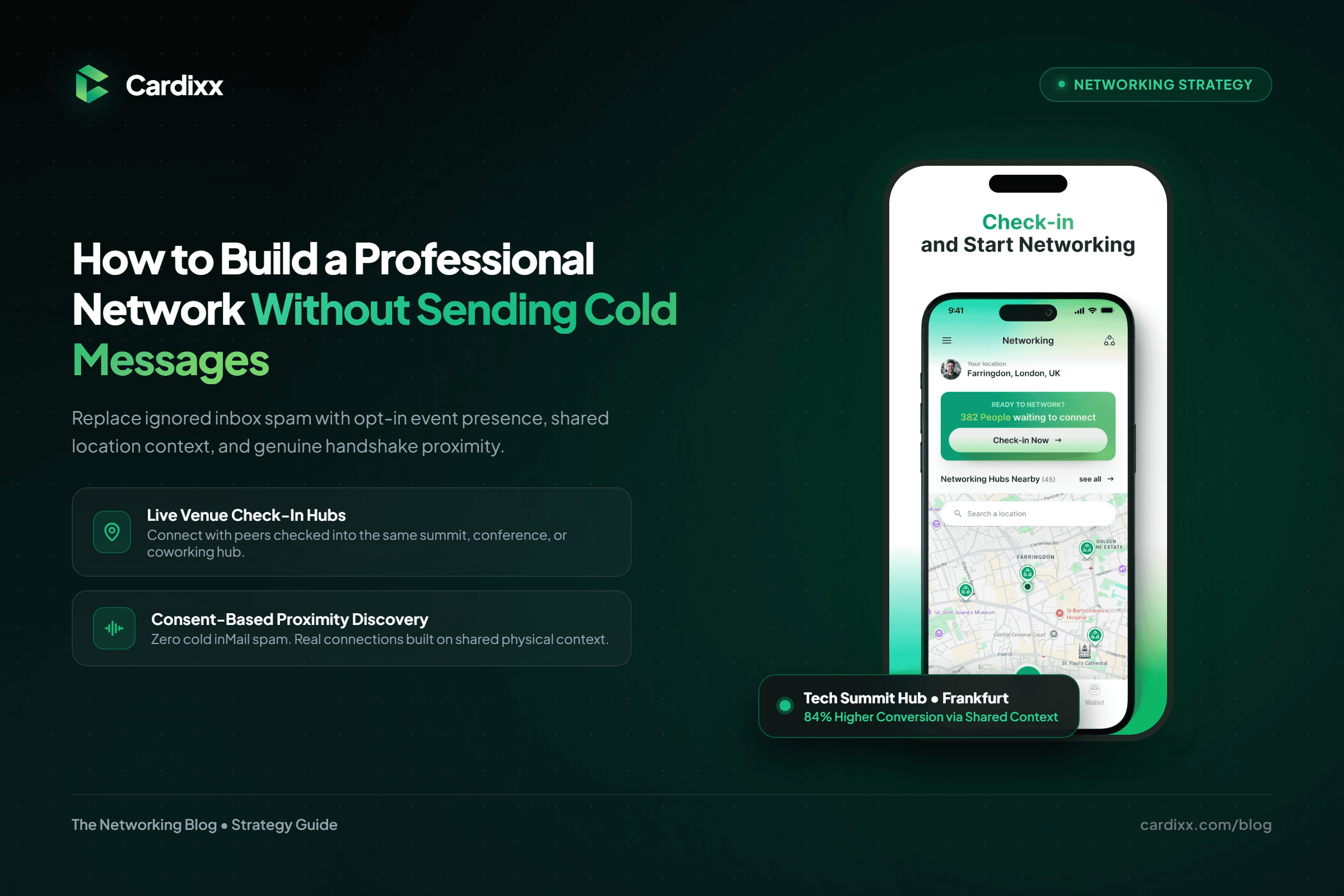
A check-in at an event, or a profile set to discoverable within a professional networking group, turns a hard question into a simple one: who nearby has already said yes to being approached. Cardixx's discovery feature works this way, surfacing people who checked in and opted into visibility rather than a cold list pulled from somewhere else.
Turning on your own visibility works the same way from the other side: it tells people your context matches theirs, so the requests that reach you carry a built-in reason. Start with finding professionals nearby.
Send the request only when you have a reason
Once the context exists, keep the ask small and specific. State the shared moment, name what you want, and let the other person decide.
A request built on real context is easy to write, and even easier to say yes to. “We were both at the product meetup Thursday, I would like to stay in touch” gives someone everything they need to decide. A blank connection request from someone you have never seen offers no such context, which is why most people leave it unanswered.
This is also where a tool that surfaces relevant people earns its place. Rather than approaching whoever happens to be senior or well known, you can find relevant people through Cardixx based on shared events, industry or intent, so the requests you send land on people with a reason to say yes.
Writing a request that gets a yes
A request built on real context is easy to write and easy to say yes to. The table below breaks the message into parts, with what to include and what to skip, so it reads as a connection rather than a pitch.
Part of the message | Include | Skip |
|---|---|---|
Opener | The shared moment or context | A generic hello |
The ask | One clear, small request | A three sentence pitch |
Length | About two lines | A long bio |
Tone | A genuine connection | Flattery and a hard sell |
What to say when you reach out
Keep the note short and specific to the moment. Reference where you met or how your fields connect, name one clear reason for reaching out, and stop there. A note that tries to sell you in three sentences reads as a pitch, not a connection.
Two lines usually cover it: what you share, and what you would like next, whether that is a short call, an introduction, or staying in touch. Skip the flattery and the long bio. The context you already share is doing most of the work.
Follow up without feeling like spam
One thoughtful follow-up beats three reminders. The table below turns follow up into a few simple rules, so a message stays welcome instead of drifting back into cold outreach.
Principle | Do this | Why it works |
|---|---|---|
Send once | One thoughtful follow-up | A second unprompted message feels cold |
Be specific | Tie it to your last exchange | Generic reminders get ignored |
Give a next step | A clear, small ask | People need something to say yes to |
Keep details current | A profile that updates in one place | Every past contact reaches your latest work |
Keep your own details current so a follow-up always points to the right information. A profile that updates in one place means every past contact reaches your latest work without a resend.
Build the habit, not just the network
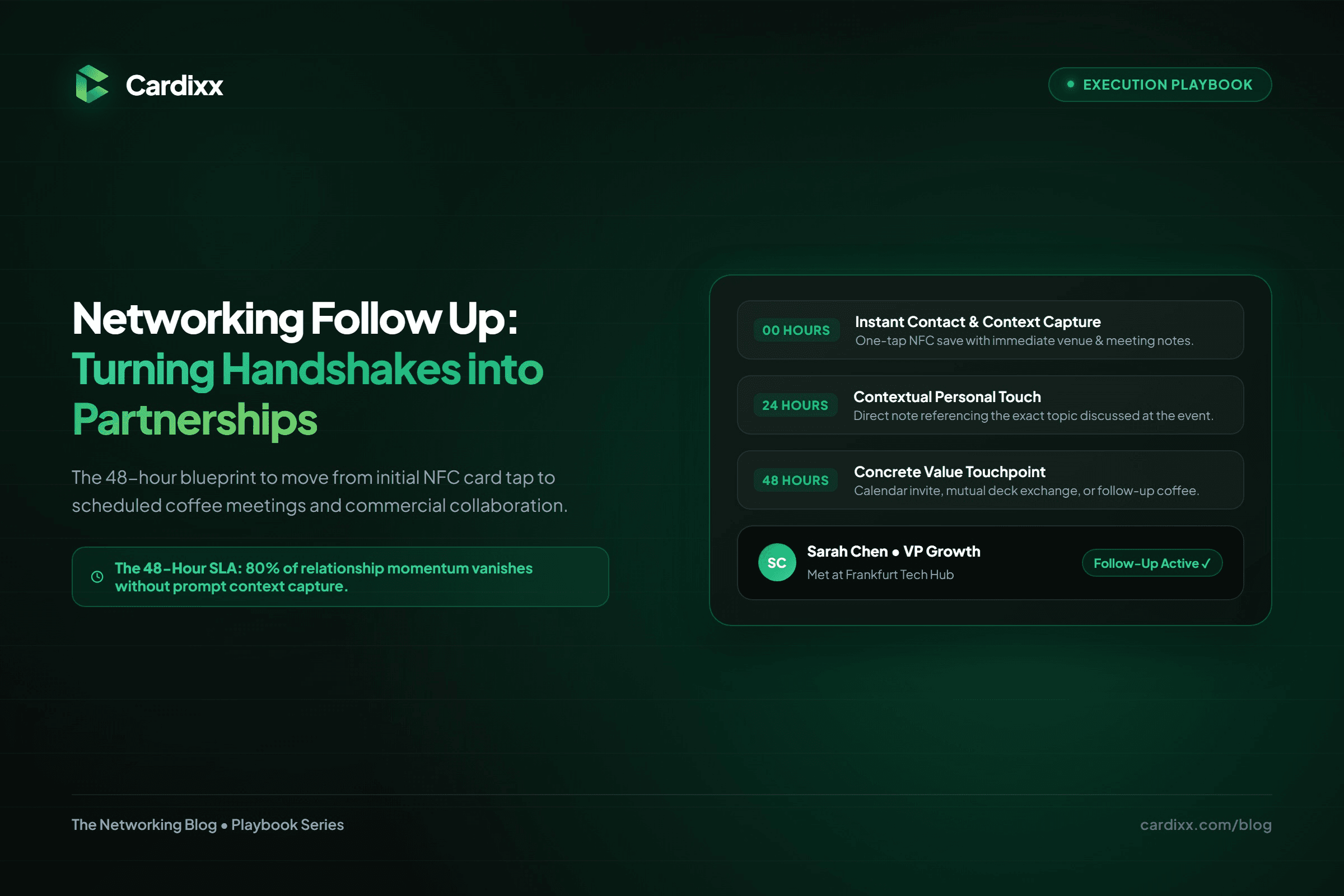
Consent-based networking works as a habit more than a single tactic. Show up to the professional networking events and groups where your field gathers, keep your own visibility on so the right people can find you, and send requests only when a real reason exists. Do that consistently, and the people in your professional network are there because they wanted to be, which is why they stay.
Consent-based networking as a habit
Consent-based networking works as a habit more than a single tactic. The table below turns it into a routine you can keep, from showing up at the right networking events to asking only when a real reason exists.
Habit | What it looks like | The payoff |
|---|---|---|
Show up | Attend the networking events where your field gathers | A steady flow of shared context |
Stay visible | Keep your own check-in and profile on | The right people can find you |
Ask with a reason | Send requests only when context exists | Higher reply rates, far less effort |
Keep it up | Do it consistently, not once | A network that wanted to be there |
Frequently asked questions
Q: Is cold outreach ever the right move?
Sometimes, for a specific, well-researched ask to one person. As a habit, it wastes effort on strangers who have no reason to expect your message. Context-based requests convert at a far higher rate for far less work.
Q: How is this different from networking passively?
Consent-based networking still requires you to act: choose events, opt into visibility, and send requests. The difference is where those requests start, from a shared moment or an opt-in signal rather than a cold guess.
Q: How does Cardixx keep requests consent-based?
People choose when they are visible by checking in at a venue or event, and connection requests go to people who opted in rather than a scraped list. Nothing on a profile is discoverable unless the person chooses to make it so.
Q: What if no one near me has opted in yet?
Start with your own visibility. Check in at the events and groups you already attend, and the pool of people who can find you, and be found by you, grows every time you do.
Q: How soon should I follow up after connecting?
Within a few days, while the shared context is still fresh, and only once. Tie the follow-up to something specific from the original meeting rather than a generic check-in.
Ready to skip the cold messages? Find relevant people through Cardixx and connect with people who already have a reason to say yes.