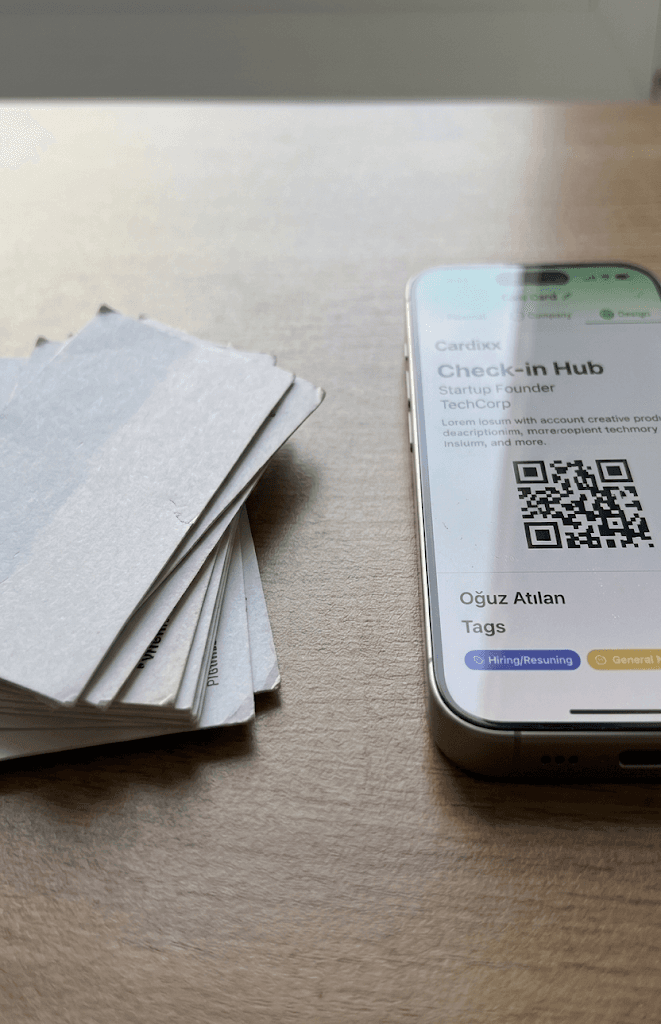

A digital business card usually beats a paper one on cost, waste and networking value. It costs little or nothing after setup, never runs out, updates in one place, and shows you who viewed it. A paper card still wins on familiarity and needs no battery. For most professionals who meet people regularly, the digital card is the better long term choice, and this guide shows exactly why.
We compare the two on the three things that actually matter, what they cost over time, what they mean for waste, and what each one does for your networking.
The quick verdict
Paper is cheap to make once and familiar to hand over. That is its strength, and for a one off event it can be enough. The moment you look past a single batch, the picture changes.
A digital business card removes the repeat printing cost, the risk of running out, and the dead end after the handover. It links to your work and tells you whether the exchange led anywhere. For anyone who networks more than occasionally, those advantages add up fast.
Feature / Dimension | Paper Business Card | Digital Business Card (e.g., Cardixx) |
Cost over time | Pay to print every batch, again and again | Free or low cost, zero reprinting fees |
Running out | High risk of running out at key events | Always accessible on your phone, never runs out |
Updating details | Must reprint the entire batch to change one detail | Update once in the app; all future views show live details |
Sharing range | Physical in-person handovers only | In-person via QR code or remote via web links, email, and social bios |
Links to work | Static printed text only | Dynamic links to websites, portfolios, calendars, and social profiles |
Networking analytics | Zero visibility on retention or engagement | Full analytics (views, clicks, and interaction context) |
Environmental footprint | High physical paper, ink, and disposal waste | Zero physical paper waste; fully paperless exchange |
First impression | Traditional, tactile, requires no battery/signal | Modern, interactive, and instantly actionable |
Digital versus paper, side by side
Here is the comparison across the factors that decide real value. Read down the two columns and the pattern is hard to miss.
Factor | Printed business Card | Digital Business Card |
|---|---|---|
Cost over time | Pay to print every batch, again and again | Free or low cost, no reprinting |
Running out | You can run out at the worst moment | Always on your phone, never runs out |
Updating details | Reprint the whole batch to change one thing | Update once, every future view shows it |
Sharing | Hand over a physical card in person | Share by QR code or link, in person or remotely |
Links to your work | None, just printed text | Links to your site, portfolio and booking |
Knowing if it worked | No way to tell if it was kept or read | Analytics show views, clicks and exchanges |
Waste | Printed cards are often discarded | No physical card to throw away |
First impression | Familiar, tactile, no battery needed | Modern, interactive, opens more information |
Paper holds its ground on the tactile first impression. On cost, updates, links, measurement and waste, the digital card does more.
Cost: the repeat bill you stop paying
A paper business card has a cost you pay again and again. Every time your number changes, your title changes, or you simply run low, you order another batch. For an active networker that is a recurring bill, plus the design and reprint time around it.
A digital business card flips that. You can start with a free digital business card app and share it as often as you like at no extra cost. A good digital business card app makes a business card digital, shareable and updatable with no per card price, no reprint when details change, and no minimum order. The cost of handing your card to one more person is nothing.
When calculating digital business card ROI versus the cost of paper business cards, the math overwhelmingly favors digital over time. Paper charges you per card forever, while a digital card shares without recurring printing limits.
Metric / Scenario | Paper Business Cards (Individual) | Digital Business Card (Individual) | Paper Business Cards (10-Person Team) | Digital Business Card (10-Person Team) |
Initial Setup & Design | $50 - $100 | $0 (Free tiers available) | $300 - $500 | $0 |
Year 1 Printing / License | $150 (2-3 print runs) | $0 | $1,500 (Multiple runs per member) | $0 - $360 (Optional team tier) |
Re-printing Costs (Rebrands/Promotions) | $100 per update | $0 (Instant digital update) | $1,000 per company-wide update | $0 |
Estimated 3-Year Total Cost | $500 - $700 | $0 - $100 | $4,000 - $6,000+ | - |
Sustainability: less printing, less thrown away
Here the honest claim is simple and worth stating plainly. A digital business card means you print fewer cards, and fewer printed cards means less paper produced and less discarded.
Paper cards are often handed over and then lost, binned, or forgotten in a drawer. Every discarded card represents paper, ink and printing that served one brief moment. Sharing via a business card QR code, direct link, or Apple Wallet and Google Wallet pass removes physical paper waste and transit carbon emissions entirely.
It is fair not to overstate this. One person's cards are a small footprint, and a phone has its own environmental cost. The point is narrower and true: choosing a digital card avoids repeated printing and the waste that comes with cards people do not keep. For a team or an event handing out hundreds of cards, that difference is real.
Environmental Metric | Paper Business Cards (1,000 Cards) | Digital Business Cards (1,000 Handovers) | Impact Reduction |
Paper Consumption | ~5 kg of high-grade cardstock | 0 kg | 100% reduction |
Discard Rate | ~88% thrown away within 1 week | 0 physical waste | Eliminates single-use paper waste |
Reprinting Waste | Entire remaining inventory discarded on detail change | Zero discarded inventory | 100% reduction in obsolete stock |
Carbon & Freight Footprint | Physical printing, packaging, and shipping transit | Instant digital transfer via cellular/Wi-Fi network | Negligible digital energy use vs. physical transport |
Networking value: where the digital card pulls ahead
This is the factor most comparisons miss, and it is where a digital card earns its place. A paper card carries your name and number and stops there. A smart digital business card carries your whole professional self and keeps working after the meeting, which is what makes it a real tool for professional networking rather than just a printed detail. Good digital business card design puts your work and your booking link one tap away.
It links to your work. A portfolio, a booking link, your site, so a new contact goes from meeting you to seeing what you do in one tap.
It tells you what happened. With digital business card analytics, you can see how many people viewed your card, which links they clicked, and where. A paper card gives you none of that. You never know if it was kept or binned.
It stays current. Change your details once and everyone who opens your live card sees the update, including people you met months ago. A paper card is frozen the day it is printed.
And with the right tool the card becomes the start of real networking, not the end of it. You can create and share with Cardixx, then check in at professional networking events, discover people nearby, and follow up, turning a single exchange into a relationship. For the mechanics of the scan itself, see the QR code business cards guide.
Where paper still makes sense
A fair comparison admits where paper wins. It needs no battery and no signal, so it works in any setting. Handing one over is a familiar gesture some people and industries still expect. And a beautifully printed card can be a tactile object that leaves an impression a screen does not.
For many, the answer is not strictly either or. You can lead with a digital business card and keep a small run of paper for the occasions that call for it. The difference is that paper becomes the exception, not the thing you depend on.
Frequently asked questions
Is a digital business card cheaper than a paper one?
Over time, yes. A paper card costs money every time you reprint or run out. A digital business card can be free to start and shares without any per card cost, so the more you network, the bigger the saving.
Are digital business cards better for the environment?
They involve less printing and less discarded paper, since there is no physical card to throw away. It is a modest but real benefit, and it grows when a team or event would otherwise hand out hundreds of printed cards.
What can a digital business card do that paper cannot?
It links to your work, updates instantly when your details change, and shows analytics on who viewed it and what they clicked. The best digital business card app, like Cardixx, also connects to check in, discovery and follow up, which paper cannot touch.
Do people still expect a paper business card?
In some industries and settings, yes. That is why many people keep a small run of paper for specific occasions while using a digital card as their main, everyday way to share details.
Can I use both a digital and a paper card?
Yes, and many do. You can lead with an app-less digital card or a reusable NFC business card for everyday meetings, keeping a minimal batch of paper cards strictly for legacy settings. A QR code business card can even sit on the paper card to link to your live digital one.
Ready to stop reprinting? Create and share with Cardixx and swap the repeat bill for a card that works harder.
Written by Cihan Yasa, M.Sc., EMBA