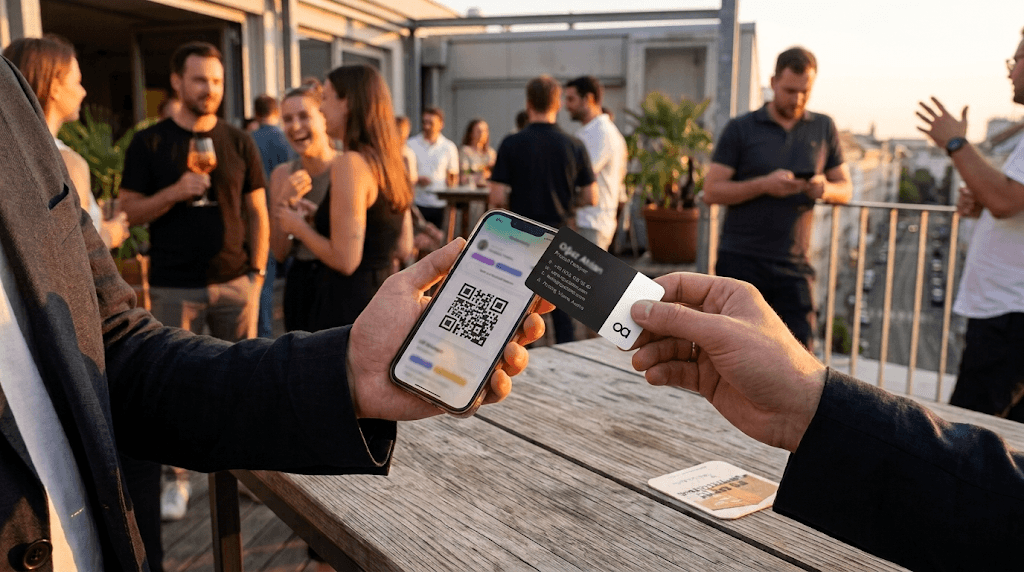

HiHello and Cardixx both give you a free digital business card, but they are built around different questions. HiHello asks how to make the best possible card. Cardixx asks what a digital card is actually for, to create an identity, or to find somebody worth exchanging it with, and builds its product around finding that person, not just presenting yourself once you have met them. This guide compares both fairly on design, pricing and what each one is actually built to do.
Neither is wrong for every use case. Read on to see where each one actually wins. For professionals and teams seeking a dynamic HiHello alternative, the primary consideration is whether you need only an electronic contact card or an end-to-end networking pipeline that actively helps you discover new contacts and follow up.
Choose HiHello if you want a well established, highly polished card with the widest range of sharing methods, including NFC tags and video calls, and strong contact management. Choose Cardixx if you want a highly customisable card that also helps you find the right people to meet, connect with them, and follow up, not just a well designed profile.
Cardixx vs HiHello at a glance
Before the detail, here is the headline comparison. The table below sets Cardixx against HiHello on the features that decide most choices, with Cardixx shown first. Both give you a free digital business card; the difference is what each is built around.
Feature | HiHello | |
|---|---|---|
Free for individuals | Yes, fully free | Free plan, paid tiers for more |
Card design | Front and back, customisable | Highly polished, many options |
Main sharing | qr code business card and link | QR, link, email, text, NFC tags |
NFC hardware | No, QR based | Generic NFC tags, no branded card |
Find people to meet | Yes, check in and discovery | No |
Follow up with context | Yes | Contact management only |
Analytics | Views, clicks, exchanges, location | On the paid Professional plan |
Personal website | One click, indexable | Not a focus |
What HiHello does well
HiHello is one of the most established names in digital business cards, and it earns that reputation on design, polish and reach. A hihello digital business card free plan supports one card with Apple Wallet, an email signature and virtual backgrounds, though inbound contact capture is capped until you upgrade. Its Professional tier unlocks more digital business card design options, custom colours, video embedding and analytics. It reports well over a million cards shared each month, runs on iOS, Android, Apple Watch and web, holds strong independent review scores, and connects to tools like Salesforce, HubSpot and Microsoft Entra ID on paid tiers, which suits a team already living in one of those systems.
It also supports several sharing methods, QR code, link, email, text and NFC tags. One nuance worth being precise about: HiHello is a software only company and does not sell its own branded NFC hardware the way Popl, Mobilo or Linq do. Its NFC support works through generic NFC tags rather than a HiHello branded physical card, so if a premium nfc business card is what you want, one of the best nfc business cards from a hardware-focused provider is a closer fit. On design breadth, sharing method variety and CRM reach, HiHello covers more ground than most rivals. From a compliance standpoint, HiHello's cloud infrastructure is anchored on US-based servers (Google Cloud Platform). For privacy-conscious organizations and European enterprises requiring strict GDPR and DSGVO adherence, data residency and third-party tracker policies are critical factors to evaluate.
HiHello pricing in full
Pricing is where a lot of buyers get surprised, so here is the full breakdown as published, current as of August 2026.
HiHello plan | Price | What it unlocks |
|---|---|---|
Free | 0 US dollars | 4 cards, Apple & Google Wallet, email signature, virtual backgrounds, capped scan capture |
Professional | 6 US dollars a month, billed annually or monthly | All in free + 16 cards, branded QR codes, analytics, contact notes and tags, unlimited scans a month |
Business | About 5 tdollars per user a month, for 5 to 100 users | Team management, CRM sync with Salesforce and HubSpot, admin controls |
Enterprise | Custom pricing, contact sales | SSO, deeper compliance, tailored rollout for large organisations |
Annual billing typically saves around 25 percent over paying monthly. The jump most solo professionals notice is Free to Professional, since the free plan caps how many inbound contacts you can capture by scanning, and Professional removes that limit along with adding analytics and branded QR codes.
What Cardixx does differently
Cardixx starts from a single question: what is a digital business card actually for, to create an identity, or to find somebody worth exchanging it with? Its answer is that a card should do both, and it builds the product around getting you from one to the other, not just around making the card itself look good.
Cardixx treats professional networking as one continuous journey, and a digital card as only the beginning of it, not the end. In practice that journey has five clear steps.
- Create. Design your digital business card, front and back, or digitize a paper card you already have.
- Check in. Mark yourself present at a venue, a coworking hub, or an event, or stay visible more broadly.
- Discover. Find nearby professionals, filtered by profession, interests, or what they are actually looking for.
- Connect. Reach out with an in app message first, or meet in person and exchange cards directly with a QR code.
- Measure. See views, clicks, exchanges and check in activity together, so you know what your networking actually produced.
That five step structure is the real difference from HiHello. HiHello is built around step one. Cardixx is built around all five, on the belief that a card sitting alone in someone's phone has not actually done its job yet.
The five-step journey: who covers it
Cardixx treats the card as step one of a five step journey. The table below shows who covers each step. HiHello is built around creating the card; Cardixx is built around all five, which is the core of the difference.
Journey step | HiHello | |
|---|---|---|
1. Create the card | Yes | Yes |
2. Check in at a venue or event | Yes | No |
3. Discover people nearby | Yes | No |
4. Connect and message | Yes | No |
5. Measure the whole journey | Yes | Card analytics only |
Cardixx feature detail beyond the five steps
Inside that structure, Cardixx also offers a highly customisable smart digital business card, and you can try Cardixx for free in a few minutes. Where HiHello gives you a single scrollable profile, Cardixx splits the card into a front and back you design separately, so one side carries your core identity and the other carries extra detail, a message, or your QR code. You can also digitize an existing paper card straight into a digital one, and share a design as a code so someone else can apply your exact layout to their own card.
Every Cardixx card can become a one click personal website that search engines can index, built from whichever fields you choose to show, and a print option is available for anyone who still wants a physical card alongside the digital one. When two Cardixx users exchange cards, the card saves into an in app wallet and stays linked to the sender's live profile rather than freezing as a screenshot, and anyone without the app can still save it as an image or straight into their phone contacts.
Cardixx digital business card analytics track total views, unique viewers, link clicks and exchanges, plus a monthly view graph and a breakdown of views by location, so the measure step has real substance behind it. For venues and hubs, Cardixx also runs a four step onboarding: apply to become a hub, go live in the app, get a dedicated hub web page, and monitor foot traffic and member activity from a dashboard.
Card design and customization compared
Design is where HiHello has a long reputation, and where Cardixx offers a different structure. The table below compares how each handles digital business card design, with Cardixx first.
Design aspect | HiHello | |
|---|---|---|
Front and back layout | Yes | Single scrollable profile |
Custom colours and layout | Yes, free | Yes, on paid tiers |
Digitize a paper card | Yes | Limited |
Share a design as a code | Yes | No |
Design depth | High, free | High, on paid Professional |
Sharing methods compared
HiHello supports the widest range of sharing methods; Cardixx focuses on a business card qr code and link. The table below lays out each method side by side, so you can match it to how you actually share.
Sharing method | HiHello | |
|---|---|---|
QR code | Yes, a business card qr code | Yes |
Web link | Yes | Yes |
Email and text | Via link | Yes |
Apple and Google Wallet | Via link | Yes |
NFC tags | No | Yes, generic tags |
Branded nfc business cards | No | No, software only |
Print option | Yes | Limited |
Analytics and measurement compared
Measurement is a core Cardixx step and a paid HiHello feature. The table below compares what each reports, so you can see how much of your networking you can actually track for free.
Metric | HiHello | |
|---|---|---|
Total and unique views | Yes | On paid plan |
Link clicks | Yes | On paid plan |
Exchanges | Yes | Limited |
Views by location | Yes | No |
Monthly view graph | Yes | No |
Check in activity | Yes | No |
Cardixx pricing in full
Unlike HiHello's four tiers, Cardixx pricing is simple to state because there is only one answer today. Cardixx is completely free for individual, B2C use, with no paid tiers, no feature caps, and no separate plan to upgrade into. Every step of the five step journey, creating a card, checking in, discovering nearby professionals, connecting, and measuring, is available at no cost.
For businesses, venues and event organisers, Cardixx does offer a B2B path, becoming a networking hub or running check in at an event, but pricing for that side has not been publicly specified, so it is not compared here against HiHello's published Business and Enterprise numbers. You can try Cardixx for free as an individual today, and contact Cardixx directly for current B2B terms.
Pricing compared
Pricing is where the two differ most plainly. Cardixx is free for individuals with no tiers; HiHello runs a free plan plus paid tiers. The table below lines the two up so you can compare a free digital business card against HiHello's published plans.
Plan level | HiHello | |
|---|---|---|
Free | Full features, no caps | Free plan, capped scan capture |
Paid individual | None needed | Professional, about 6 USD a month |
Team | B2B, contact for terms | Business, about 5 USD per user |
Enterprise | B2B, contact for terms | Custom pricing |
Where HiHello is the stronger choice
Be fair about this. If your priority is a highly polished card with the most design options, video embedding, and every possible sharing method including NFC tags and video calls, HiHello covers more ground today. Its longer track record and wide CRM integrations also make it a safe, proven choice for teams already invested in that ecosystem, and its published Business and Enterprise pricing gives a buyer a clear number to plan around.
Where Cardixx is the stronger choice
If your problem is not the card itself but what happens next, finding the right people and remembering to follow up, Cardixx is built specifically for that. Its check in, discovery and in app connection steps do not have a direct equivalent in HiHello, which focuses on the card and contact management rather than helping you find new people to meet. The ability to digitize an existing paper card, share a design as a code, turn your card into an indexable personal website, and use a print option alongside the digital card are also specific to Cardixx among the two, and the entire individual experience is free.
Networking and discovery compared
This is the row where the tools diverge most. HiHello focuses on the card and contacts; Cardixx adds a full professional networking layer around it. The table below compares the discovery and follow up capabilities, with Cardixx first.
Capability | HiHello | |
|---|---|---|
Check in at networking events | Yes | No |
Discover people nearby | Yes | No |
Filter by interest or intent | Yes | No |
Connect and message in app | Yes | No |
Follow up with context | Yes | Contact notes only |
Built for the networking journey | Yes | Card and contacts focus |
Which one should you choose, by use case
Match the tool to the situation you are actually in, not just the feature list.
A solo professional who wants the most polished possible card, with video, multiple designs and a proven track record, should lean toward HiHello Professional. A team already living in Salesforce or HubSpot, that wants card management folded into an existing CRM workflow, should lean toward HiHello Business. A buyer whose decision is driven mainly by certified compliance and admin controls should lean toward HiHello's Business or Enterprise tier and confirm the exact certifications directly.
Someone whose real problem is not the card but what happens next, finding the right people at networking events or a coworking space and actually following up, should lean toward Cardixx, especially since the entire individual experience is free. You can try Cardixx for free and compare it directly against your current HiHello plan if you already use one. For a wider view of the market beyond these two, the best digital business card apps compared guide covers more options.
Which to choose, by use case
The honest rule is to match the tool to your situation. The table below turns that into a quick decision, naming the best fit and why for each common case.
Use case | Best fit | Why |
|---|---|---|
Most polished card, video, NFC | HiHello Professional | Design breadth and sharing methods |
Team living in a CRM | HiHello Business | Salesforce and HubSpot sync |
Compliance and admin driven | HiHello Enterprise | Certifications and controls |
Finding people and following up | Check in, discovery, free | |
Free individual with networking | The whole journey at no cost |
Frequently asked questions
How much does HiHello cost compared to Cardixx?
HiHello runs Free, Basic at about 3 to 4 US dollars a month, Professional at about 6 to 8 US dollars a month, and Business at about 5 to 6 US dollars per user a month, with custom Enterprise pricing. Cardixx is completely free for individual, B2C use today, with no paid tiers. Pricing for Cardixx's B2B side, hubs and events, has not been publicly specified.
Is Cardixx or HiHello better for digital business cards?
It depends on what you need. HiHello offers more card design options and the widest range of sharing methods including NFC. Cardixx focuses on what happens after the card is shared, discovery, connection and follow up. Neither is universally better, they solve different parts of networking.
Does Cardixx have NFC like HiHello?
No. Cardixx shares by QR code and link only. HiHello supports NFC as one of several sharing methods. If tap to share hardware matters to you, HiHello covers that; Cardixx focuses on the networking layer around a QR based card instead.
Is HiHello or Cardixx free?
Both offer a free plan for individuals. HiHello's free tier supports multiple basic cards, with design, video and analytics on its paid Professional plan. Cardixx offers full card creation and sharing for free, with its networking features built around the card.
Can Cardixx find new people to meet, unlike HiHello?
Yes. Cardixx includes check in and discovery features that help you find relevant professionals nearby, which is not a focus of HiHello. HiHello concentrates on the card itself and managing contacts you already have.
Which is better for a sales team, Cardixx or HiHello?
HiHello has established CRM integrations with tools like Salesforce and HubSpot, which suits teams already built around those systems. Cardixx suits teams that want networking activity, discovery and follow up, tracked around the card itself. Compare based on which workflow your team already uses.
Want the card to do more? Try Cardixx for free and see the networking layer HiHello does not offer.
Written by Cihan Yasa, M.Sc., EMBA