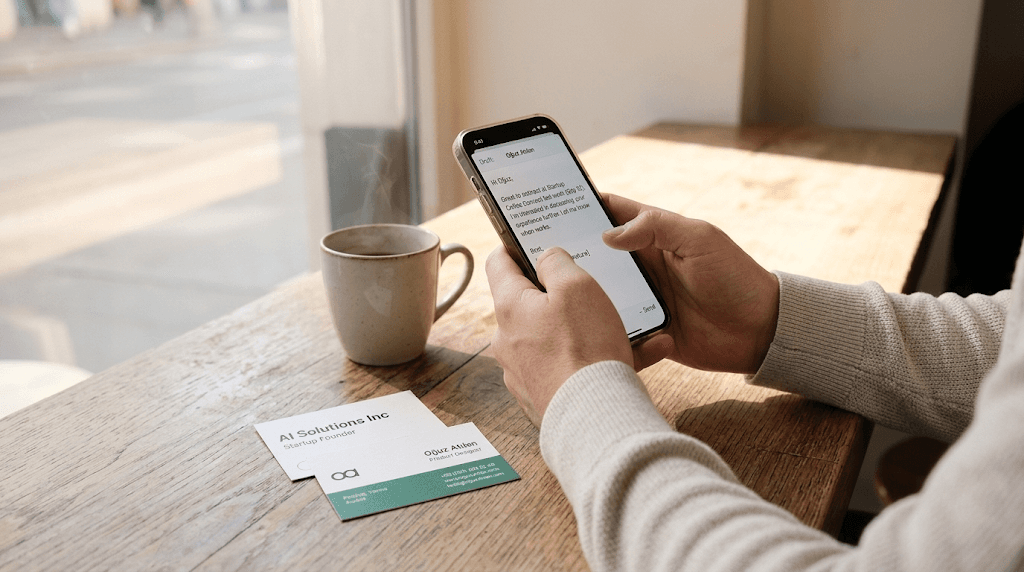

A digital business card shares your details through a business card qr code or a link, with no hardware to buy or carry. An NFC business card shares them through a chip you tap against a phone, which means buying a physical card. Both hand over your contact details fast. The real choice is whether you want zero setup and instant sharing, or a premium physical object you tap.
This guide compares the two side by side, explains where each one wins, and helps you pick the style that fits how you actually meet people.
The quick answer
If you want something that works right now, from the phone in your pocket, with nothing to order and nothing to replace when your details change, a digital business card that shares by QR code is the simpler choice. As a modern NFC business card alternative, an app-less digital system eliminates the typical 30 to 60 upfront cost per physical card, as well as the 15% annual loss rate common during business travel If you like the feel of handing over a physical card and tapping it against a phone, and you do not mind buying and carrying it, an NFC business card suits that style.
Most people who just want their details shared quickly land on the QR based digital card, because there is no hardware between them and the exchange. Cardixx is built this way, around QR sharing, so you can share a card without buying anything extra.
What each one actually is
A digital business card is an online card you share by showing a QR code or sending a link. The other person scans or taps the link, your card opens in their browser, and they save your details. Nothing physical changes hands, and nothing needs to be manufactured.
An NFC business card is a physical card, or a tag or band, with a small NFC chip inside. When someone holds their phone near it, the chip sends a link to your details. NFC business cards feel smooth to use, and the card can look and feel premium, which is part of the appeal. An NFC digital business card still points to an online profile, so the tap is just the delivery. The trade is that you have to buy the card, carry it, and reorder if your design or details change enough.
Both usually point to the same kind of destination, a digital profile with your contact details and links. The difference is the delivery, a scan or a link versus a tap on a chip.
Feature / Dimension | QR-Based Digital Business Card (e.g., Cardixx) | Physical NFC Business Card |
Primary Exchange Method | Displaying a QR code on a screen or sending a web link | Tapping a physical card, tag, or band against a smartphone |
Hardware & Stock Required | None; lives completely on your smartphone or web browser | Requires purchasing, carrying, and maintaining a physical card |
Upfront & Ongoing Cost | Zero setup cost; free tiers available with instant updates | Upfront physical card purchase plus reorder costs if physical design changes |
Device & Camera Compatibility | 100% universal (Works with standard camera on iOS/Android) | Compatible with most modern phones; older devices may lack active NFC support |
Remote Sharing Capabilities | Shared via email, social bios, calendar invites, or direct link | Requires face-to-face physical proximity for the chip tap to work |
Maintenance & Replacement | Always on your phone; impossible to forget or run out of stock | Can be misplaced, damaged, left behind, or run out of inventory |
Digital versus NFC, side by side
Here is how the two compare on the factors that decide the exchange.
Factor | Digital (QR based) card | NFC business card |
|---|---|---|
How it shares | Scan a QR code or open a link | Tap a chip against a phone |
Hardware needed | None, just a screen or a printout | A physical card or tag with an NFC chip |
Upfront cost | Can be free to start | You buy the physical card or tag |
Works with any phone | Yes, camera reads the code | Most modern phones, but not all older ones |
If you forget the card | Still works from your phone screen | You cannot tap without the physical card |
Updating your details | Update once, every scan shows the new version | The link can update, the card itself cannot be reprinted |
Sharing remotely | Send the link by message or email | Needs a tap in person, or a QR or link as backup |
Best fit | Anyone who wants zero setup and easy sharing | People who want a premium physical object to tap |
The table makes the pattern clear. NFC wins on the feel of a premium physical object. A QR based digital card wins on cost, on always having it with you, and on needing no hardware at all.
Where an NFC business card wins
NFC deserves a fair hearing, because for some people it is the better fit.
The tap feels premium. Holding out a well made card and tapping it against a phone is a small moment of polish. The best nfc business cards use quality materials for exactly this impression, and if your brand leans on that feel, it can be worth it.
It works without opening anything first. The person does not have to open a camera or point at a code. They just bring their phone close. Especially when used as a trade show lead capture app, physical cards from providers like Popl, Mobilo, or Linq enable rapid, back-to-back taps at an exhibition booth to transfer contact details in seconds. A smart business card nfc chip makes quick, repeated taps at a booth feel smooth.
It doubles as a keepsake object. A physical NFC card sits in a wallet or on a desk as a reminder, which a screen does not. Some people value that presence.
Technical / Operational Factor | QR Code Digital System | NFC Physical System | Winner / Trade-Off Analysis |
Speed of Exchange | 3-5 seconds (Open screen -> Scan camera) | 1-2 seconds (Direct tap on device) | NFC wins for raw in-person speed; QR wins on overall convenience. |
Information Dynamism | Updates immediately across all past & future links | Contact profile updates, but physical card branding/layout remains static | QR Digital wins; zero lock-in or physical waste on job title changes. |
Fallback & Reliability | Works offline or via screenshot if screen is visible | Requires QR code printed on the back as a fallback for non-NFC phones | QR Digital wins; built-in redundancy requires no second delivery method. |
Analytics Capabilities | Comprehensive (Views, unique visits, link clicks, venue context) | Tracks destination URL clicks, but cannot track physical card views unless tapped | QR Digital wins; tracks engagement regardless of whether shared in-person or online. |
Where a digital, QR based card wins
For most people, most of the time, the QR based digital card removes more friction.
There is nothing to buy. You can start with a free digital business card app and share it today, with no order, no shipping, no minimum quantity. A good digital business card app has you sharing within minutes.
You always have it. The card lives on your phone, so you can never leave it at home or run out. You can also save your pass directly to Apple Wallet or Google Wallet, letting you present your QR code from your phone's lock screen without opening an app. sIf your phone is with you, your card is with you.
It works on any phone with a camera. Scanning a QR code needs no special chip in the other person's device, which avoids the rare case where an older phone does not read a tap well.
You can share it remotely. A QR based card is also a link, so you can send it before a meeting, in an email signature, or in a message, not only in person. NFC needs the tap to happen face to face.
It updates without a reorder. Change your details once and every future scan shows the new version. There is no card to reprint and no chip to rewrite.
Can you have both?
Yes, and many people effectively do. Because an NFC card almost always also carries a QR code or a link as a backup, the QR based method is the common denominator. You can run entirely on a QR based digital card, and if you later want a physical NFC object, the two can point to the same profile.
Cardixx focuses on the QR based side, so you can use Cardixx without extra hardware and share your card from your phone straight away. Choosing a digital business card without NFC requirements ensures 100% universal compatibility across every modern iOS and Android device. If you want the deeper how to on the scan method, see the QR code business cards guide.
Which one fits your style?
Choose the QR based digital card if you want zero setup, no cost to start, a card that is always on you, and the option to share remotely. That covers most professionals, most freelancers, and anyone who meets people in mixed settings.
Choose an NFC card if the physical feel is part of your pitch, you meet people mostly in person, and you are happy to buy and carry a card and reorder when things change. It is a style choice as much as a practical one.
Whichever you lean toward, the destination matters more than the delivery. A great digital business card profile, one that is current, well designed and easy to act on, is what actually wins the follow up, whether people reach it by tap or by scan.
Professional Style / Scenario | Best Fit Solution | Key Strategic Reason |
Freelancers & Consultants | QR-Based Digital Card | High flexibility; instant updates to rates and portfolio without physical reprinting |
Remote Workers & Virtual Networkers | QR-Based Digital Card | Essential for remote outreach, calendar links, and email signatures where physical tapping isn't possible |
High-End Corporate Executives | Hybrid / NFC with QR Backup | Combines the tactile, premium experience of a physical card tap with the reliability of a QR fallback |
Event Attendees & Booth Exhibitors | QR-Based Digital Card | Facilitates continuous, rapid contact collection without worrying about running out of physical stock |
Budget-Conscious Professionals | QR-Based Digital Card | Eliminates physical production costs while delivering a fully dynamic contact profile |
Frequently asked questions
What is the difference between a digital business card and an NFC business card?
A digital business card shares your details by QR code or link and needs no hardware. An NFC business card shares them through a chip you tap, which means buying a physical card. Both open a digital profile, the difference is scan or link versus tap.
Do I need an NFC card to have a digital business card?
No. A digital business card works entirely through a QR code and a link, straight from your phone. NFC is an optional physical add on, not a requirement. Cardixx works without any NFC hardware.
Is a QR code or an NFC tap better?
Neither is better for everyone. A tap can feel smoother in person, while a QR code needs no hardware, works on any camera phone, and can be shared remotely as a link. Most people choose QR for the lower cost and convenience.
Does an NFC business card still work if the other person has an old phone?
Most modern phones read NFC, but some older ones do not, or have it switched off. That is why most NFC cards also include a QR code as a fallback, so the exchange still works either way.
Can I switch from an NFC card to a digital one?
Easily. Since both point to a digital profile, you can move to a QR based digital card at any time and keep the same details and links, without the ongoing cost of reordering physical cards.
Prefer zero setup? Use Cardixx without extra hardware and share your card straight from your phone.
Want more than a card? Get the full networking journey. Download Cardixx free on the App Store, Google Play, or cardixx.com. |
Written by Cihan Yasa, M.Sc., EMBA