
A digital business card is far more than a static contact transfer; it is a live entry point into your professional ecosystem. When a founder hands over a digital profile, the interaction does not stop at saving a phone number, it immediately connects the prospect to live pitch decks, real-time product updates, and interactive calendar availability. For freelancers and speakers, this means every scan delivers an active presentation of your work rather than a passive piece of paper that gets forgotten in a pocket. By linking your card directly to dynamic destinations, you convert a brief 10-second meeting into an ongoing, measurable engagement.
The best digital business card examples lead with different things depending on who you are. A founder leads with the company and what they are building. A freelancer leads with proof of work. A speaker leads with talk topics and a showreel. A job seeker leads with the role they want and their strengths. Same tool, different front page, and this guide shows exactly what each one should put first.
Below are four worked examples plus a quick side by side, so you can picture your own card and copy the structure that fits you. Each one is a smart digital business card that turns a plain business card digital and shareable, ready for real professional networking.
The examples at a glance
Here is what each type of professional should lead with, link to, and ask the reader to do. Find your row and build from there.
Persona | Primary Identity Headline | Primary Proof Element | Single Preferred Call-to-Action (CTA) | Common Distraction to Avoid |
|---|---|---|---|---|
Founder / Co-Founder | Company Name, Role, & 1-line Value Prop | Company Website or Pitch Deck | Book a Meeting / Request Intro | Excessive personal social links |
Freelancer / Contractor | Craft / Specialty in plain terms | Portfolio, Case Studies, or Showreel | Book a Call / Hire Me | Long biography or wordy self-description |
Keynote / Event Speaker | Core Topics & Notable Past Venues | Video Showreel or Speaker One-Pager | Inquire for Booking / Check Availability | Unrelated side projects or non-speaking services |
Active Job Seeker | Target Role & Key Competencies | Tailored Resume or Work Samples | Contact Me / View Availability | Wall of text listing all past non-relevant jobs |
The pattern is the same for everyone. Lead with the one thing you want remembered, link to the proof, and give a single clear action. What changes is the content, not the shape.
Founder example
A founder is selling a company as much as a self. Your card should make it obvious what you are building and why someone should care.
Lead with your company, your role, and a one line on what you are building. Not a vague mission, a plain sentence a stranger understands. Link to your company site or, if you are raising or partnering, a deck or a page that makes the case. Your one action is usually to book a meeting or request an intro.
Leave off the clutter. A founder card crammed with every social link buries the point. Keep it to the company, the proof, and the ask.
Freelancer example
A freelancer is selling proof. The card that wins work puts your best work one tap from the person who just met you. A strong digital business card for freelancers leads with the work, not the words.
Lead with what you do in plain words and a link to your portfolio or two strong case studies. Your one action is to book a call or hire you. For the full version of this, the digital business cards for freelancers guide goes deeper, but the example here is simple: name, craft, proof, and a clear way to book you.
Leave off the long bio. A prospect wants to see the work, not read your life story. Let the professional portfolio do the talking.
Speaker example
A speaker is selling a stage presence and a set of topics. Organisers at business networking events who find your card need to know what you talk about and that you can hold a room.
Lead with your talk topics and the professional networking events where you have spoken. Link to a showreel or a speaker page with past talks and testimonials. Your one action is a booking or enquiry form so an organiser can reach you fast. A short, punchy card beats a long one here, because organisers scan quickly.
Leave off unrelated work. If you speak on leadership, an organiser does not need your unrelated side projects competing for attention.
Job seeker example
A job seeker is selling readiness and fit. Recruiters and hiring managers who get your card should immediately see the role you want and why you are strong for it.
Lead with the role you are targeting, a short professional summary, and two or three strengths that back it up. Link to your professional resume or a portfolio, whichever proves your case best. Your one action is a contact link or a short note on your availability. A clean, confident card signals exactly the professionalism a hiring manager is looking for.
Leave off anything that muddies the message. If you are targeting a design role, a wall of unrelated experience distracts from the fit you are trying to show.
How to build your version
Once you know your row in the table, building the card is quick. The best digital business card app lets you copy this structure in minutes, and the examples share a shape you can reuse.
Persona | Initial Scan Moment | Landing Experience | Immediate Conversion Goal | Long-Term Relationship Value |
|---|---|---|---|---|
Founder | Meeting investors or potential partners at events | Opens live profile with deck and calendar | High-value intro call or pitch meeting | Strategic partner or investor acquisition |
Freelancer | Networking at a meetup or cold outreach pitch | Opens live portfolio and starting package rates | Direct booking for a discovery call | Retainer contract or direct project hire |
Speaker | Event organizer scanning a badge or slide deck | Opens speaker page, past clips, and inquiry form | Receiving a formal speaking invitation | Recurring event bookings and media exposure |
Job Seeker | Exchange with recruiters or hiring managers | Opens clean target summary and tailored resume | Scheduling an initial screening interview | Employment offer or talent po |
Pick the layout that fits your goal, then choose your Cardixx card format. Cardixx gives you a front and back you design separately, so you can lead with your identity on one side and your proof, topics or resume on the other. For the mechanics of building and styling it, focus on your digital business card design, and for the bigger picture, the digital business card guide.
Whatever your role, the rule holds. Lead with one thing, prove it with a link, and give a single clear action. Everything else is noise.
Card Side | Core Objective | Recommended Included Elements | Visual / Layout Focus |
|---|---|---|---|
Front Side | First Impression & Core Identity | Name, Photo, Title/Role, Short Summary, QR Code | High clarity, minimal noise, bold branding colors |
Back Side | Secondary Depth & Conversion | Interactive Links (Portfolio, Deck, Calendar), Social Proof, Primary CTA | Action-oriented buttons, organized link stacks, clear next steps |
Many modern professionals wear more than one hat. A founder may also be an active keynote speaker; a full-time employee might handle freelance consulting on the side. The true advantage of an advanced digital card platform is the ability to maintain multiple distinct profiles under one roof. Instead of handing a generic card to a specialized audience, you can toggle between your "Founder Card" for investor meetups and your "Speaker Card" for conference organizers. This ensures that whichever audience you face, the first thing they see is tailored precisely to what they care about most.
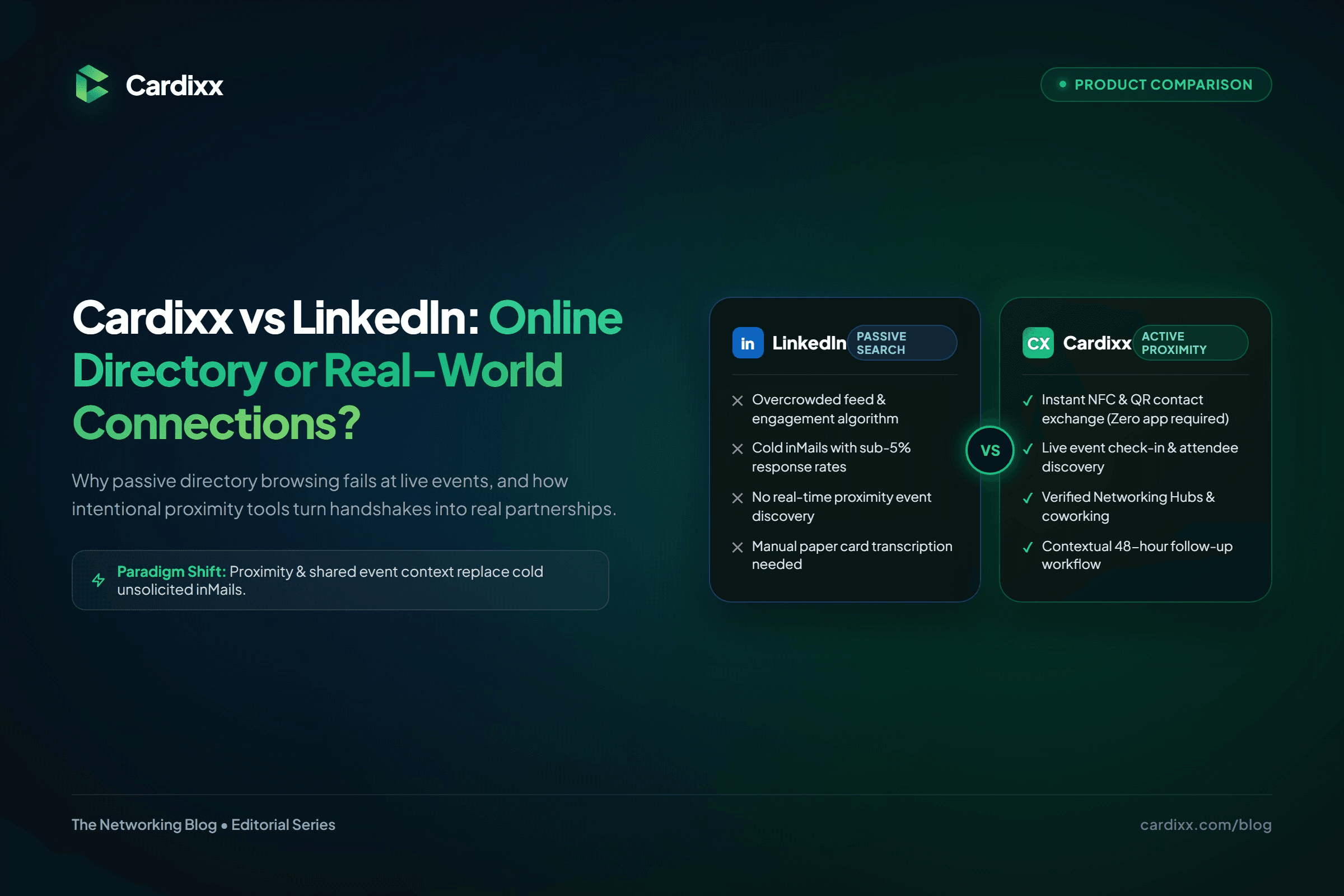
Creating an exceptional digital business card solves the presentation puzzle, but finding the right people to share it with remains the ultimate objective. Modern networking tools bridge this gap by pairing your card with proximity-based venue check-ins and community discovery features. By checking in at industry conferences, coworking spaces, or networking events, your tailored profile becomes discoverable to relevant peers nearby. This turns your card from a tool that waits for an introduction into an active engine that generates new professional connections before you even step across the room.
Frequently asked questions
What should a digital business card include?
Your name, what you do, one key link to your proof, and one clear action. What you lead with changes by role: a founder leads with the company, a freelancer with work, a speaker with topics, a job seeker with the target role.
What is a good digital business card example for a founder?
A founder card leads with the company, the role, and a plain line on what they are building, links to the company site or a deck, and asks the reader to book a meeting or request an intro. It keeps social clutter off the card.
How is a freelancer card different from a job seeker card?
A freelancer leads with proof of work and a way to hire them. A job seeker leads with the role they want and the strengths that fit it, linking to a resume or portfolio. Both lead with one clear message and a single action.
Can I have more than one digital business card?
Often yes. Many tools, including a free digital business card app, let you create separate cards for different roles or contexts, so you can show a speaker card to an organiser and a consulting card to a client, each leading with what matters to that audience.
What should I leave off my card?
Anything that competes with your main message. Too many links, a long bio, or unrelated work all bury the one thing you want remembered. Lead with the point, prove it, and give a single next step.
Found your example? Choose your Cardixx card format and build the card that fits how you work.