
Your professional digital identity and online professional presence are how you show up when someone looks you up online. It is the sum of your profile, your work, your contact details, and the trail people find when they search your name. A strong one makes you easy to find, quick to trust, and hard to forget. This guide shows you how to build one, piece by piece, and keep it working for you.
We cover what a professional digital identity is, why it matters, the parts that make it credible, and how to bring them together so a stranger who meets you today can find and remember you tomorrow.
What a professional digital identity actually is
When someone hears your name at an event, gets your card, or reads it in an email, many of them do the same thing. They look you up. What they find in those first few seconds is your professional digital identity.
It is made of a few things working together. Your professional profile, the one on a network like LinkedIn or XING. Your own presence, a personal website or page that you control. Your contact details and the links to your work. And the smaller signals: a professional email address, a clear photo, a short professional summary that says what you do.
None of these is your identity on its own. Together they decide whether a stranger trusts you enough to reply, meet, or buy. Building a professional digital identity means making those pieces consistent, current, and easy to reach.
Why your professional digital identity matters
People decide fast. Before a first meeting, a potential client, employer, or partner has often already searched you. If what they find is thin, out of date, or scattered across half-finished profiles, you lose ground before you say a word. Making yourself consistently findable and trustworthy is the foundation of personal branding.
A clear identity does three jobs. It makes you discoverable, so the right people can find you at all. It builds credibility, so what they find makes them trust you. And it makes you memorable, so weeks later they still know who you are and how to reach you.
This matters most at the moment of professional networking, when you meet someone new and both of you are deciding whether this contact is worth keeping. If you are new to the idea and wondering what professional networking in practice is, it is simply the work of meeting the right people and staying worth remembering, and your identity is what carries you between those meetings. A strong identity turns a brief introduction into a lasting connection.
The building blocks of a credible professional profile
A professional profile earns trust through a handful of parts. Get these right, and the rest follows.
Start with a clear name and photo. A real, current photo and your actual name do more for trust than any clever tagline. People connect with a face.
Write a short professional summary or professional bio. Two or three lines on who you are, what you do, and who you help. This is the professional summary a reader scans first, so make it plain, not padded. The same short summary works on a professional resume, so a clear professional summary for resume use doubles as your introduction here.
Use a professional email address. An address on your own domain or a clean personal one reads as more credible than a random handle. It is a small signal that carries weight, and a matching professional email signature reinforces it.
Add a real photo. Professional photos beat a blank avatar every time, because people trust a face they can see. You do not need a professional photographer or a studio, just a clear, current picture of you.
Link to your work and your proof. A professional portfolio, case studies, published pieces, or professional references that back up what you claim. Proof beats claims, and references beat adjectives.
Keep your contact details reachable. A phone, an email, a booking link, whatever you actually want people to use. An identity people cannot act on is a dead end.
Profile, personal website, and digital card: how they fit together
These three get confused, so here is how they relate.
Your profile on a professional network gives you reach. Sites like LinkedIn and XING put you where recruiters and peers already look, and they carry social proof. These professional networking sites are where many people start when they check who you are. The limit is that you do not own the page, and everyone on it looks broadly the same.
Your personal website or page gives you control. You decide what it shows, how it looks, and what it links to. A personal website makes you findable on your own terms, and a page that search engines can index helps the right people reach you when they look you up.
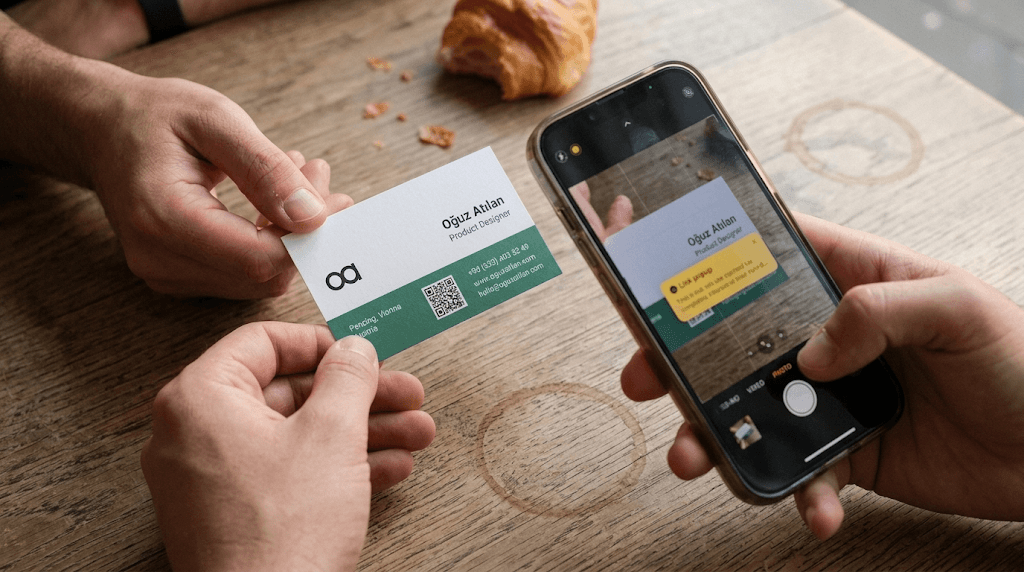
Your digital business card gives you the handshake. It is the piece you hand over in person or by link, and it should point back to the rest of your identity that they can save to Apple Wallet or Google Wallet. A good digital business card is not a dead end; it opens the door to everything else about you.
These work best together. The card starts the connection, the page holds the detail, the profile carries the reach. If you want the full picture of the card layer, read the digital business card guide and the QR code business card guide for sharing by scan.
Identity Component | Primary Role & Function | Ownership & Control | Core Strengths | Key Limitation |
Professional Network Profile (e.g., LinkedIn, XING) | Reach & Credibility: Provides social proof on established platforms where peers and recruiters search. | Platform-Owned (Fixed layout, subject to platform rules and templates) | Built-in network reach; established domain authority and instant social validation. | Rigid formatting makes users look identical; purely passive (waits for visits). |
Personal Web Page | Ownership & Searchability: Acts as a centralized hub indexed by search engines for your complete identity. | Full Control (Complete authority over structure, content, and design) | Search engine discoverable on your own terms; tailored showcase of work and proof. | Does not natively drive targeted traffic or enable frictionless 1-on-1 contact exchange. |
Digital Business Card (e.g., Cardixx) | The Handshake: Bridges initial contact moments by handing over live, actionable contact data. | High Control (Editable fields, front/back customization, selective privacy) | Frictionless sharing (QR/link); live auto-updates; analytics on views and link clicks. | Acts as an entry point; requires two people to interact or share a direct link. |
Proximity Check-In & Discovery | Active Relationship Building: Turns static trust into real-world professional connections. | User-Driven (Control over visibility, location check-ins, and filters) | Discovers nearby professionals by industry/intent; converts profile trust into active meetings. | Requires physical presence at networking venues/events and active check-in participation. |
How to build your professional digital identity with one tool
You can assemble all of this by hand across several services, or you can build the core of it in one place, inside a single digital business card app. Cardixx is designed for the second path.
With Cardixx, you can build your professional identity with Cardixx starting from a digital card you design front and back, then turn it into a personal page that other people can open, and that search engines can index, so you become easier to find when someone looks you up. Your details, your summary and your links live in one profile you keep current, rather than scattered across old accounts.
The point is not to replace your professional network. It is to give you a single, current, shareable identity you control, that points to everything else and updates in one place when your details change. A smart digital business card that links to your page and your work does more for your identity than a static card ever could.
How to keep your identity trusted over time
An identity is not built once and forgotten. It stays credible only if you tend it.
Keep it current. When your role, focus or contact details change, update them in one place so every version people reach shows the same, correct information. Nothing erodes trust faster than a dead link or an old job title.
Stay consistent across places. Your name, photo, and summary should match across your card, your page, and your profiles. Consistency reads as reliability.
Watch how people engage. If your tool shows analytics, you can see how many people viewed your profile, which links they opened, and what they cared about. This turns a static identity into something you can actually improve, because you know what people look at.
Where a professional profile alone stops being enough
Here is the honest limit. A profile, however polished, mostly sits and waits. It helps people who already found you, but it does not go and find the right people for you, and it does nothing to turn a view into a real conversation.
That is where identity meets action. Once your identity is set, Cardixx lets you check in at a venue or professional networking events, become visible to other professionals nearby, and discover people worth meeting based on profession, interests, or intent. Your identity is what makes those people trust you when they open your card.
So your identity gets people to trust you. The discovery, the check-in, and the follow-up are what put that trust to work.
Frequently asked questions
What is a professional digital identity?
It is how you appear when someone looks you up online: your professional profile, your personal page, your contact details and the work people can find under your name. A strong one makes you easy to find, trust and remember.
Is a LinkedIn profile enough on its own?
A profile on a network like LinkedIn or XING gives you reach and social proof, but you do not control the page, and everyone looks similar on it. Pairing it with a personal page and a shareable card that you control makes your identity stronger and easier to act on.
How do I make my professional profile easy to find?
Use your real name and photo, write a clear professional summary, keep your details current, and publish a personal page that search engines can index. Consistency across your card, page, and profiles helps people and search engines connect them to you.
Do I need a personal website to have a strong identity?
It helps, because a page you control is findable on your own terms. You do not need to build one from scratch. A tool that turns your profile into a shareable, indexable page gives you most of the benefit with far less effort.
How does a digital business card fit into my identity?
The card is the handshake you hand over in person or by link. A good one points back to your fuller identity, your page, your work, and your contact details, so a brief meeting leads someone to everything else about you.
Ready to start? Create your Professional Digital Identity with Cardixx and turn every scan into a connection worth keeping.
Written by Cihan Yasa, M.Sc., EMBA